Synopsis:
Cressida, Adam's talented sister, is invited to perform at Fortescue's festival of young talents and Adam tags along. But once the children arrive at the festival, in a mountain-top hotel, their terrific talents begin to mysteriously disappear. A piano virtuoso suddenly forgets how to play, a maths genius finds she can no longer multiply.
There's a sinister shadow that only Adam ever sees, a strange glow emanating from behind closed doors. With the help of an erratic ex-racing driver, dashing Amy Swift, Adam and Cressida rip-roar off through the mountains in perilous pursuit of the dastardly talent thief.
Review (Spoilers):
The Talent Thief was an interesting book set in an alternate world in the 1920’s or 1930’s. It explored both the advantages and disadvantages of having special talents. The author aptly described the attitude of some talented individuals who believe themselves to be the only ones of importance through his characterisation of Hans, a gifted musician who was spoilt by his fame.
The main characters of the story are sixteen year old Cressida who has an amazing singing voice and her twelve year old brother Adam who believes he has no talent. They are invited to a festival of young talents in the city of Paralin.
Williams demonstrates how talented people such as Cressida can feel so put upon and pressurised by their respective gifts that they can become quite cruel even though they might not ordinarily be so cutting and spiteful. I think that in the book Adam was more accepting of Cressida’s cruel remarks and petulant behaviour than was realistic. However, Williams did show the change in Cressida’s character over the book.
The mysterious Talent Thief called Nipso did not really have much opportunity to develop in the book as he was always uncertain and easily fooled. However, he does begin to make some sensible decisions instead of simply doing as he is told as the book progresses. It would be interesting to observe what further progress he makes in understanding peoples’ intentions. Also, a more detailed explanation of how the Talent Thief can use the talents of others should have been given.
This book was highly enjoyable and worth a read as it had action, adventure and humour; all essential ingredients for a good book. The conclusion of the book was slightly disappointing; though the main adventure had drawn to an end, a number of questions remained unresolved.
Did Cressida and Adam go back to live with their horribly selfish uncle or did they stay with Amy Swift? Will the creature Nipso choose to return to the jungle or journey to find Cressida? How wil Adam and Cressida go about returning all the talent spheres they have salvaged to the right people? Also, surely they will have to attempt to catch the real talent thief.
Book Rating: 4/5
Cover Rating: 4/5
Author: Alex Williams
Friday, 22 July 2011
Thursday, 7 July 2011
Review: Divergent (Divergent #1) by Veronica Roth
Synopsis (from Goodreads):
In Beatrice Prior's dystopian Chicago, society is divided into five factions, each dedicated to the cultivation of a particular virtue—Candor (the honest), Abnegation (the selfless), Dauntless (the brave), Amity (the peaceful), and Erudite (the intelligent). On an appointed day of every year, all sixteen-year-olds must select the faction to which they will devote the rest of their lives. For Beatrice, the decision is between staying with her family and being who she really is—she can't have both. So she makes a choice that surprises everyone, including herself.
During the highly competitive initiation that follows, Beatrice renames herself Tris and struggles to determine who her friends really are—and where, exactly, a romance with a sometimes fascinating, sometimes infuriating boy fits into the life she's chosen. But Tris also has a secret, one she's kept hidden from everyone because she's been warned it can mean death. And as she discovers a growing conflict that threatens to unravel her seemingly perfect society, she also learns that her secret might help her save those she loves . . . or it might destroy her.
Review (With Spoilers):
I read Divergent by Veronica Roth because it came highly recommended; so many people said they enjoyed it. The synopsis sounded promising and I was excited to read it, however I was setting myself up for a big disappointment.
Characters:
Tris, the main character, seemed okay at first, however my estimation of her rapidly declined. She was so shocked when her brother chose to join Erudite and almost perceived it as a betrayal when she herself chose Dauntless. Furthermore, the unrealistic speed with which she discarded her faction traditions and values and took on those of Dauntless made her insincere and cold. Within the space of the first week she could no longer be recognised as having come from Abnegation, what with all her new clothes, tattoos and attitude.
The book did not explain why her divergence should make her better at using weapons; throwing knives, shooting guns and fighting in general. It did say why she would be better at simulations but not why she would be a superior fighter. It was too much, too quick.
I knew as soon he was introduced that Four, also known as Tobias, would be the love interest. From the moment he helped her out of the net, Tris experienced an inexplicable feeling towards Four.
Though Four was eighteen and Tris was sixteen, the very fact that he was her instructor made the relationship inappropriate and unpalatable. The Dauntless leaders were never seen and this was highly unrealistic. Why wouldn't they meet the new initiates and take more of an interest in their training?
Eric, the head Dauntless instructor, was a nasty piece of work whose aim in life was to be as horrible as possible to as many people as possible. His rivalry with Four was childish as no other angle was provided to the readers as the Dauntless leaders were never present. Tris' friendship with Christina felt very fake and forced. One moment, they liked each other and the next moment they couldn't stand each other's company.
Tris' parents were 2D characters as they weren't present in much of the book. The opening of the book was pretty much the end of their family life. This was a mistake as Tris would relate memories of her family life and none of this was shown actively. Furthermore, Tris' parents were killed far too quickly to make much of a lasting impression on the reader.
Also, towards the end of the book, her father's morals are under scrutiny. Even after his wife was killed, he insisted that killing was wrong. However, a few minutes later, after a couple of words from Tris, he was shooting to kill. This seemed inconsistent.
Janine, the Erudite leader and the evil mastermind of the book, didn't come across as frightening enough as she should have been. She wrote a few horrible articles about Tris' father and she also drugged the Dauntless into submission. They became her mindless automatons, willing to follow her every command. Janine's actions were cruel and calculating, but when Tris met her in the flesh, Janine didn't have the aura of power that other villains usually do.
Setting:
Divergent takes place in a futuristic version of Chicago. They have some technology but much of the infrastructure has been destroyed. The fence surrounds the whole city and only certain people can enter and leave. The question of whether the city was being guarded or whether the inhabitants were being imprisoned was never resolved. The city has trains that seem to go around 24/7 in an endless circuit and people have to take their lives into their hands to get in and out.
Style:
The pace of Divergent was slow and wearisome. I took a few days' break in the middle. I had to force myself to persevere but it wasn't worthwhile unfortunately. Divergent was in first person, present tense following the trend set by the Hunger Games by Suzanne Collins. It was effective in that particular series but Tris' narrative voice was grating on the nerves.
Ending:
The ending wasn't satisfactory. It wasn't as self contained as it could have been. It was written as a first instalment of a trilogy. The ending could definitely have been improved. The book ending with Tris and Tobias on a train is an indication of which way the series is heading; in circles.
Discrepancies:
Why didn't the girls and the boys have separate dorms? This was inappropriate and meant everyone lacked privacy especially with all the raging hormones, getting your towel pulled off in front of everyone and someone being stabbed in the eye.
Tris outgrew her pants after a week of training which is highly unlikely and downright silly.
Why didn't Tris attempt to phone or email either her brother or her parents as the situation became more urgent? Did phones still exist? Computers were being used.
After Tris was shot, she was still doing a lot more than she should have been able to. Her gunshot wound didn't seem to bother her much.
Tris killed her friend Will without flinching but could not bare to shoot Tobias, even to the point where she stood there passively and told him to shoot her instead. This didn't seem a very brave thing to do to me and she couldn't have known this would have broken him out of his trance.
The whole reason for Tobias' father being present in the control centre was to disable the computer, but he didn't do anything at all to help. The only reason he was there was so that he would be on the train afterwards.
Conclusion:
Divergent by Veronica Roth was not a worthwhile read as it left me frustrated. The ending was anti-climactic and rushed. I was baffled as to what the reason for it being compared to the Hunger Games was as they are completely different. I will not be reading the next book, Insurgent. If only I had known how bad it was before I read it, I wouldn't have wasted my time.
Book Rating: 1/5
Cover Rating: 4/5
Author: Veronica Roth
Wednesday, 11 May 2011
Tagged
Velvet at vvb32 reads tagged me in this fun quiz!
1) If you could go back in time and relive one moment, what would it be?
Countdown to the millenium. Watching the fireworks with my family and eating popcorn. (Everyone was scared about the millenium bug and the end of the world.)
2) If you could go back in time and change one thing, what would it be?
My genes.
3) What movie/TV character do you most resemble in personality?
None.
4) If you could push one person off a cliff and get away with it, who would it be?
My neighbour. (But I wouldn't. Because then I would be a murderer. Just saying:)
5) Name one habit you would like to change in yourself.
Overthinking!
6) Describe yourself in one word.
Pessimist.
7) Describe the person who named you in this meme in one word.
Fun :D
8) Why do you blog? Answer in one sentence.
I like to read books and I wanted to keep a record of my thoughts because I tend to forget details.
Be warned- If you read this, you've been tagged!:)
Monday, 18 April 2011
Review: Oranges in No Man's Land by Elizabeth Laird
Synopsis from book cover:Ayesha doesn't know why they're fighting. But she does know that war has ripped her city in two- and that the enemy lives on the other side of no man's land.
Since her mother died in a shell attack and her father left the counry to find work, Ayesha has lived in a battle-scarred building with her granny and her two little brothers. Now Granny has run out of medicine and it looks like she's going to die too.
But Ayesha won't let that happen. She'll do anything to find a doctor, even make the forbidden journey across the dangerous and desolate no man's land...
Background:
Set in Lebanon during the civil war, this story is told by award-winning author Elizabeth Laird and is based on personal, real-life events. Elizabeth stayed on the green line in Beirut in 1977 in a war-damaged flat with her husband and six-month-old son. Memories of her son sleeping in a suitcase on the floor, taking his first steps on the bullet-riddled balcony, playing with the soldiers on the checkpoint, and her husband racing through no man's land in the buildup to a battle have all inspired this gripping and moving story.
Elizabeth Laird says, "When I wrote Oranges in No Man's Land, I didn't know that Lebanon would be plunged back so soon into a nightmare. Caught up in that nightmare are children like Ayesha and Samar, whose lives political leaders so easily throw away."
Review:
Oranges In No Man's Land is a poignant, thought-provoking story. I picked it up because I have read loads of books by Elizabeth Laird and they have been consistently great. As well as this, the title made me curious.
As it is aimed at young children, the plot was quite simple. Ayesha, the main character, is a young girl who just about escapes a shell attack along with her grandmother and her two brothers. Unfortunately, her mother was not so lucky.
They then live in a building with many other homeless people trying to escape the dangers of the civil war. Food is scarce; Ayesha and her grandmother go down to the checkpoint to get what they can when the food truck comes. Ayesha makes friends with a deaf girl called Samar and tries to learn sign language. The problem arises when her grandmother runs out of medicine. Ayesha will do everything that she can to find her the medicine that she needs, even cross no man's land to find a doctor.
Ayesha's daring decison to cross no man's land and the outcome of that only takes place over a couple of hours. She was very brave as she put her own life at risk to find medicine for her grandmother even though no one asked her to. The reason for the civil war isn't explained in detail in the book due to the fact that it is narrated from Ayesha's point of view and she is very young.
The main point of the story is to show how nice people can be even in times of hardship, even though they are on opposing sides of enemy lines. Also, it shows how brave people can be during times of war. I liked Ayesha and believe that young readers would be able to relate to her. In the end, the story wraps up without leaving any questions unanswered. Oranges In No Man's Land is a short, strong story with a clear message and I would recommend it to younger readers.
Rating: 5/5
Cover: 5/5
Concept: 5/5
Author: Elizabeth Laird
Friday, 11 March 2011
Review: The Enemy (The Enemy #1) by Charlie Higson
Synopsis from Goodreads:
Review (with spoilers):
Book Rating: 4.5/5
Concept: 4/5
Cover: 5/5 (It's actually much nicer in reality)
Author: Charlie Higson
They'll chase you. They'll rip you open. They'll feed on you...
When the sickness came, every parent, policeman, politician - every adult - fell ill. The lucky ones died. The others are crazed, confused and hungry. Only children under fourteen remain, and they're fighting to survive.
Now there are rumours of a safe place to hide. And so a gang of children begin their quest across London, where all through the city - down alleyways, in deserted houses, underground - the grown-ups lie in wait. But can they make it there - alive?
Review (with spoilers):
I picked up The Enemy because the synopsis sounded fantastic- and it turned out the content was great for the most part. What would it be like to live in a world without adults? Would there be any order or would it be every girl and boy for themselves?
The Enemy answered these questions. The world has turned into a dark and uncertain place and the reader follows a large group of kids as they cross London in hopes of a better and safer place to live, away from the infected Grown ups.
First of all, I wish that there had been one character from the beginning to the end that I could have called the 'main' character. Though I liked the different perspectives of all the characters and the bigger picture this afforded me through characters such as Maxie, Achilleus, Callum, Ollie and Ben and Bernie, I wanted one character I could have felt especially close to.
My favourite characters were probably Small Sam- who was small but very brave- and Arran- who I thought would be the main character, but who gave me a great shock when he died quite early on in the book. I was thrown by his death because I was sure he was going to be the 'main' character that I wanted as other characters spoke about him like he was an anchor and because he was the leader.
However, this just goes to show how uncertain life in a post-apocalyptic society is. There were a lot of deaths in The Enemy due to the Grown up-infested streets and I felt sad for some of the characters who died but was glad that the other characters paid respect to them or remembered them.
I was surprised when Blue and Maxie got together at the end because I hadn't seen anything that indicated that they liked each other romantically. I liked level-headed Ollie but knew what he was up to towards the end of the book regarding spying on David and gathering information. I felt annoyed by Callum. I did feel sorry for his situation but wished he would have changed and gone in search of his friends or at least fought back against the Grownups.
The story was fast paced, action packed and detailed. As expected, there was violence and some strong language. I enjoyed Higson's story-telling. Though the word 'zombie' was only used once or twice in the book, the infected adults had almost all the symptoms of zombies, so I think it would be safe to call them that.
I wanted to know more about how the 'sickness' and how it started. I knew it was hard enough for the children to just survive, but I was hoping that they would want to find out how the sickness had started. We're given a little clue that it has something to do with sunlight or the air, but hopefully more will be revealed in the next book. I wanted to know why some of the adults died straight away and why some of them took longer to die.
Though the enemy are the Grownups, the most evil characters were definitely Nick and Rachel; a pair of cannibals living in the underground. They appeared so nice at first and this just made them all the more evil when the truth was finally revealed. When there's no food, cannibalism is a solution for some and the addition of these two characters definitely made the story more authentic and the characters' situatuons all the more desperate. How had Nick and Rachel survived the sickness and how had they known to go underground?
I really wanted a big fight at the end of The Enemy between David's group and the Holloway group but this didn't transpire unfortunately. Though, it might have meant there would have been some casualties, it would have been exciting to read.
Overall, The Enemy was an exciting, action packed story.The plot was very strong and there were some shocks and surprises at the end. I read this in a matter of days because I wanted to know what would happen next. I'm looking looking forward to reading the next book, The Dead (which it turns out, is actually a prequel and with different characters). I would recommend The Enemy to people who enjoy lots of action, violence and post-apocalyptic worlds. Oh, and zombies.
Book Rating: 4.5/5
Concept: 4/5
Cover: 5/5 (It's actually much nicer in reality)
Author: Charlie Higson
Monday, 7 March 2011
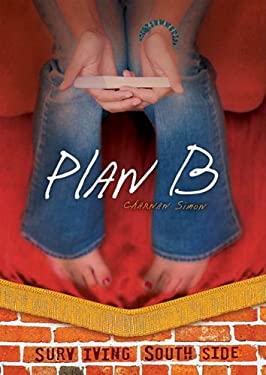
Review: Plan B by Charnan Simon
Synopsis from Goodreads:
Is this happily ever after? Lucy has her life planned out: she'll graduate and then join her boyfriend, Luke, at college in Austin. She'll become a Spanish teacher and of course they'll get married. So there's no reason to wait, right? They try to be careful. But then Lucy gets pregnant. Now, none of Lucy's options are part of her picture-perfect plan. Together, she and Luke will have to make the most difficult decision of their lives.
Review:
Plan B was an interesting book. I read it because I wanted to learn more about teen pregnancies and the consequences. However, at only a hundred pages, it didn't have much room to delve into the issues at a great length.
The story was quite typical and there weren't any great shocks or surprises. Pretty much all the characters reacted how I thought they would. I didn't like how quickly some of the characters got over their feelings or changed their mind. Realistically, it would've taken them longer to be accepting. Plan B needed more depth.
I did like all the characters because they were interesting and I sympathised with them, especially Lucy. They would be memorable characters if they had been more complex. Perhaps the author intended it this way so that all readers would be able to relate to the characters and find similarities, but it didn't work for me.
This would be a great book to read in a Health class because Plan B is a template to work from. The ending was open and left many questions. Discussing the possible answers would be helpful in a class environment. The reader never finds out what Lucy will do past the first doctor's meeting. This uncertainty was a theme of the book and I wasn't surprised that it ended in this way, however, I prefer closed endings and thus would like to have known what happened next.
Overall, Plan B was an enjoyable book to read as it highlighted some questions on the issue of teen pregnancies. The story takes place before the start of Lucy's pregnancy and ends around the two month mark.While it did discuss many of the issues, like if Lucy would get to go to college, it wasn't with any great depth. I really did want to know what happened next. Plan B is worth a read.
Rating: 3/5
Concept: 3/5
Cover: 3/5
Monday, 28 February 2011
Review: Among The Hidden (Shadow Children #1) by Margaret Peterson Haddix
Synopsis from Goodreads:
Rating: 5/5
Concept: 5/5
Cover: 4/5
Author: Margaret Peterson Haddix
This review is part of Dystopian February at Presenting Lenore.
Luke has never been to school. He's never had a birthday party, or gone to a friend's house for an overnight. In fact, Luke has never had a friend.
Luke is one of the shadow children, a third child forbidden by the Population Police. He's lived his entire life in hiding, and now, with a new housing development replacing the woods next to his family's farm, he is no longer even allowed to go outside.
Then, one day Luke sees a girl's face in the window of a house where he knows two other children already live. Finally, he's met a shadow child like himself. Jen is willing to risk everything to come out of the shadows -- does Luke dare to become involved in her dangerous plan? Can he afford not to?
Review:
Among The Hidden was a great book. I really enjoyed it. It was fast paced, gripping and had me on tenter-hooks. It had great twists and turns with a few shocks in store. The main character, Luke Garner, was excellent. The reader was informed of his thoughts, feeling and perceptions about his restricted world. I felt like I was with Luke during every moment of his extremely difficult experiences.
According to the authorities, he should not have existed which made him a fugitive and a prisoner in his own home. Before the construction of the housing development, Luke had a bit more space to roam around due to the encircling woods. After they were cut down, Luke had to retreat into his house and finally to the attic. Although his family loved him, his presence was dangerous for them and they began to perceive him as a nuisance. They continuously worried about his movements being noticed by the neighbours.
As he was not supposed to exist, the threat of the Population Police that could sweep down on him at any moment, was an ominous and palpable presence throughout the book. The law forbidding a third child in a family was created because the government thought that there wasn't enough food in the world for everyone. Therefore, his every mouthful was perceived as a crime.
I felt really sorry for Luke as he felt guilty for something he had no control over. It was such a terrible situation to be in but it was very realistically portrayed. Jen Talbot was an inspirational character for Luke. She, too, was a third child. She was inspirational because she told Luke to be brave, to not feel guilty for the simple fact of existing and to take a risk for greater gain. She had a permanent effect on his life as she was the catalyst that propelled him into the dramatic events that would follow in the succeeding books.
In the finale, Luke gets help from an unexpected source and he, as well as the reader, are first suspicious and then, pleasantly surprised by these turn of events. Overall, Among The Hidden was a fantastic book and a great dystopian book. I first read this six years ago and then again now and it has remained a favourite. Read it and immerse yourself in Luke's world.
Rating: 5/5
Concept: 5/5
Cover: 4/5
Author: Margaret Peterson Haddix
This review is part of Dystopian February at Presenting Lenore.
Sunday, 27 February 2011
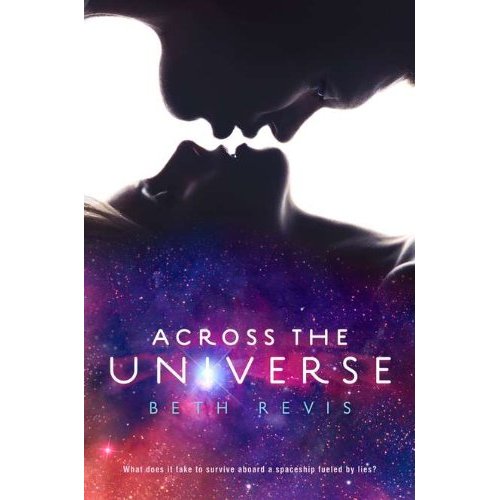
Review: Across The Universe by Beth Revis
Synopsis from Goodreads:
A love out of time. A spaceship built of secrets and murder.
Seventeen-year-old Amy joins her parents as frozen cargo aboard the vast spaceship Godspeed and expects to awaken on a new planet, three hundred years in the future. Never could she have known that her frozen slumber would come to an end fifty years too soon and that she would be thrust into the brave new world of a spaceship that lives by its own rules.
Amy quickly realizes that her awakening was no mere computer malfunction. Someone-one of the few thousand inhabitants of the spaceship-tried to kill her. And if Amy doesn't do something soon, her parents will be next.
Now Amy must race to unlock Godspeed's hidden secrets. But out of her list of murder suspects, there's only one who matters: Elder, the future leader of the ship and the love she could never have seen coming.
Review (with spoilers):
I was excited to read Across The Universe because not only did the synopsis promise an amazing story inside but I'd read a lot of great reviews for it and thus knew that a lot of people liked it and therefore, there would be a strong likelihood that I would too.
I enjoy sci-fi and watching Star Trek. Alas, I didn’t enjoy Across The Universe for the most part. I’ve read Across The Universe can be read by people who don’t necessarily read or enjoy sci-fi but the story left me with a lot of questions.
Technology
The beginning was interesting as Amy makes the decision to go with her parents (in a cryogenic state) on a journey to another planet that would take 300 years to complete. The process of Amy and her parents being put into stasis was very detailed, however Revis had not explained why they were leaving Earth in the first place and I believe that this was an essential piece of information that was overlooked.
Nothing major like an apocalypse could have taken place as Amy wondered about how Jason (her boyfriend) had probably got married and had children and now, 300 + 1 years later, his descendants would be alive on Earth. Furthermore, I wanted to know when the probe that was originally sent to the destination planet left Earth and when (if ever) it came back as Godspeed left in 2036. Shouldn’t the probe have been able to detect signs of life? Additionally, I wanted to know how many light years away the destination planet was meant to be as this is the first thing one should ask when travelling on a space ship.
While the description of how they were put into stasis was thorough, I wasn’t given the reason for why tubes were pushed down their throats. I thought it was because they couldn’t breathe the blue liquid in, but it turned out that they had to breathe that in anyway. Furthermore, though they put eye drops in so they wouldn’t go blind, they didn’t put anything in their ears so they wouldn’t go deaf. Also, how was Amy able to hear through the ice whilst in stasis as the ice would have covered her ears?
The reason for why the ship left a year late was not explained. Nonetheless, human cargo should be put on last. The cryochamber should have had more failsafe devices as there was only one alarm for all the chambers. When the temperature of the frozen person rises, the lid should open automatically so they don’t drown. These felt like grave technological oversights. Amy was pushing at the lid of her chamber when she woke up, but realistically, her muscles wouldn’t have been working properly to even lift her arms.
In truth, the ship had been travelling for more than 450 years, so the cryochambers would have broken down as they were made for a journey lasting 300 years. The question of how many chambers were there in total wasn’t answered. How did the Doctor (and the previous doctors) maintain all of them and repair them if they broke as there would only be a certain amount of spare parts in stock.
There was some interesting technology mentioned in Across The Universe such as grav tubes (similar to elevators but the person needs to be connected to the wi-com system) and floppies- slim, handheld computers. I was surprised there wasn’t better CCTV on board and especially in the cryochamber level. The explanation for how the ship had functioned for so long was that renewable fuel was being used but it didn’t go any deeper than that.
Just before they were cryogenically frozen, Amy’s father gave her the option of remaining on Earth and told her he didn’t think she would come with them. Amy was torn but decided to follow her parents, however, the reader later learns that she didn’t have a packed trunk. For 301 years they took an empty trunk that could have been filled with educational books or other essential equipment.
Content
There were some scenes of a sexual nature which were very graphic and explicit. There were also mentions of incest and some violence. There was nudity and suicide. Amy was the victim of attempted rape which was one of the most shocking moments in the book. As can be seen, Revis deals with some tough and sensitive subjects. However, the one thing that is altered is the swearing, as can be seen from the use of ‘Frex.’
Elder
I grew frustrated of Elder as the story went on; this was mostly due to his ignorance. Throughout the entirety of the book, Elder has only one lesson with Eldest and that is to find the three causes of discord- difference, lack of a strong central leader and finally, at the end of the book he is told the third one- individual thought. Just because Eldest didn’t like him or trust him, didn’t mean that Elder couldn’t have been more forceful in asking for lessons. If he was going to be the next leader, he needed to be educated.
Perhaps the most unbelievable thing was that he didn’t even know the date of when the Plague had happened. Elder admitted to Amy that Eldest had told him about the Plague but that he didn’t know when it had happened. I found this strange because the first question someone asks about an event that happened in the past, is when it happened. If Elder didn’t even know the date of the one significant event that had taken place on Godspeed, I didn’t think he could be a leader.
I found the romance side to be quite dull. As soon as he sees Amy, Elder was enamoured with her. He lusted after her a lot and described her ‘sunset’ hair increasingly as the story went on and this became tedious to read. It seemed like it would become a love triangle with the introduction of Harley, but Amy and Elder were too wrapped up in each other to even notice him sinking into depression.
What annoyed me was when Elder berated Harley for looking at the stars and not keeping watch of the frozens when he, himself hadn’t even taken a watch (actually, Elder doesn’t take a watch until very near the end of the book. Amy didn’t take a watch at all even though she constantly worried over whether her parents were being murdered at that moment).
When Elder does finally take a watch over the frozens, he goes to sleep immediately in front of the elevator which defeated the purpose of a ‘watch’. The straw that broke the camel’s back was that Harley and Elder took their watches without a weapon at hand. They were trying to catch a murderer and they weren’t even armed. What was Harley going to do with only a paint brush? Paint the murderer to death? Why did Elder think the murderer would be scared of him if he saw him sleeping there? They wouldn’t be.
I’d figured out who the murderer was long before it unfolded in the story so it wasn’t a surprise. The list of suspects wasn’t that long. There should have been a few more red herrings thrown in. I realised who the ‘middle’ elder was as well; Orion. As I said, there weren’t many characters to pick from. What I found strange was that Eldest and Doc had never seen the middle elder once in sixteen years, even though he was just there, in the recorder hall. Eldest kept saying he was the leader of the ship, yet he didn’t even know who was running the recorder hall.
All my uses of Elder, Eldest and middle Elder in this review sounds complicated as it’s hard to tell who is who. In Across The Universe, Elder/Eldest are not differentiated from each other in any way, not even by numbers, thus making everything that much more complicated. It’s not even known how many Eldests there have been. Also, it would be very hard to talk about them. The only other Eldest they discussed was the ‘Plague Eldest’, but what was the one after him called? Or the one after that one?
At the end of the book, Elder tells Amy that he unplugged her. I knew that this had been a strong possibility. By this point, I had realised that Elder was as bad as Eldest and the middle Elder. This is because Eldest was prepared to kill people if it suited his purposes and he drugged the populace into submission. Middle Elder callously killed frozens and calmly killed Eldest.
Elder too killed the middle Elder as it suited his purposes. He killed him just when middle Elder was about to reveal to Amy that Elder had unplugged her. Though it was said that he may still be alive, in my opinion, the chances of that would be very slim as he wasn’t prepped at all; the tubes weren’t down his throat, the eye drops hadn’t been put in and so on. He cannot be brought back from that totally unharmed.
When reading, I asked myself why Eldest and Elder would have the same access clearance. I understand that they’re clones and thus have the same DNA but logically, Eldest would have clearance for some of the more top secret information that he wouldn’t want Elder to know. It would have been pretty easy to use voice recognition software instead of fingerprints as their voices are not the same.
Amy
I liked Amy to begin with but as the story went on I felt that she was slow to figure out what was going on and to find the link between the victims which was pretty obvious. At the end, she doesn’t figure out that Steela is going to be killed until after it happens. Also, I didn’t know why she would put the information on her wall as anyone would be able to walk in and see it, including Eldest and Doc.
Though Eldest had threatened to kill her and hadn’t, he didn’t even confine her to her room, or to the Feeder Level. She was allowed to go wherever she pleased even though many of the populace weren’t allowed to. At the end, Amy states that she would correct Earth’s records but she doesn’t know enough to change much.
Other questions I had included:
• Why didn't Orion kill all the frozens at once rather than going around killing them one by one?
• Why would he mark his targets with red Xs as this would let everyone know his targets?
• Why did he pull all the trays out but not flick the switch? You would do it as you went along.
• How did Orion know they might be changed into slaves by the frozens once they reached the planet? And if Eldest told him, how did he know?
Overall, Across The Universe had an interesting premise which I was excited to read about. The pace was slow in the middle, but the beginning and end were good pace-wise. The story had a lot of potential in the beginning and the world Revis created was quite solid and unique. For me, the story picked up at the end but it was too late by then. It left me with a lot of questions. However, people will enjoy Across The Universe if they are looking for light sci-fi with a bit of mystery and romance.
Rating: 2.5/5
Concept: 4/5
Cover: 5/5
Author: Beth Revis
This review is part of Dystopian February at Presenting Lenore.
Thursday, 24 February 2011
Review: The Water Wars by Cameron Stracher
Synopsis from Goodreads:
Welcome to a future where water is more precious than gold or oil-and worth killing for
Vera and her brother, Will, live in the shadow of the Great Panic, in a country that has collapsed from environmental catastrophe. Water is hoarded by governments, rivers are dammed, and clouds are sucked from the sky. But then Vera befriends Kai, who seems to have limitless access to fresh water. When Kai suddenly disappears, Vera and Will set off on a dangerous journey in search of him-pursued by pirates, a paramilitary group, and greedy corporations. Timely and eerily familiar, acclaimed author Cameron Stracher makes a stunning YA debut that's impossible to forget.
Review (with some spoilers):
Rating: 3/5
Concept: 4/5
Cover: 4.5/5
Author: Cameron Stracher
This review is part of Dystopian February at Presenting Lenore.
Review (with some spoilers):
I wanted to read The Water Wars because of the environmental issues that I knew it would focus on. I wanted to see how people would survive in a world where water is hard to come by. I've seen Water World and enjoyed it.
The cover was interesting and piqued my curiosity. However, the cover is less to do with the character is depicts (Kai) and more to do with the two main characters, Vera and Will, siblings who go on a perilous journey to find him. Though Kai is spoken about a lot in the story, he isn't present as much as I would have liked him to be.
The story opened well. I was able to form a picture of the world Vera and Will inhabited and noted the stark contrast between their lack of water and their access to some sorts of technology and even a gaming centre. I wished Stracher would have given more details on how they lived without water. How did they wash their clothes? What exactly is a 'dry shower'? How do they wash utensils?
They went to school and lived with their parents and one day, Vera makes a friend at the bus stop; Kai. Kai and Vera became friends a little too quickly. In truth, they should have been more wary of eah other, Vera especially due to all the warnings from her dad.
A month goes past. I think this month should have been explained more. What happened? It was crucial for the development of the characters. Later, Kai tells Vera of a river's existence, which is unheard of in this dystopian world. Vera tells Will and when they go to Kai's apartment to ask him to show it to them the next day, they see the signs of a struggle, a kidnap, and a dead body in the room.
Vera wants to rescue Kai and after some persuasion, Will helps her. At this point, the story speeds up rapidly. Knowing that they and their parents could be in danger, they leave their parents ignorant of what's going on and go off to find Kai based on little to no evidence and a hunch. It turns out that these hunches kept cropping up as the story went on. Vera would always think of another place to try to find Kai and she somehow knew what most of their captors' motives were.
It was a little too convenient when Vera and Will were always captured or rescued just in the nick of time. Most often, others saved them rather than them saving themselves. Another criticism is that the story felt too sketchy. There was a lot of action but the story wasn't detailed enough. It felt as though Vera and Will were swept along in the action, journeying from one place to another without much sense of direction.
There were too many baddies and organisations for me to keep track of. Whilst reading, I couldn't remember what some of the acronyms stood for, such as PELA and WAB. Additionally, there were the Minnesotans, the Illinowas (Illinois and Iowa, I believe), the water pirates and Bluewater. This meant that there were too many characters that weren't developed; ranging from Kai who was introduced early on in the story to Torq, who appears at the end. Characters disappeared quickly from the story and others were introduced hastily, such as Sula.
Sula conveniently turned up in the story just when Vera and Will needed her and it wasn't believable at all. I couldn't understand why some of the characters who appeared to be 'bad' at the start helped the two main characters, for example, Ulysses. There was a reason for him helping Vera and Will, but overall, some of these characters didn't have strong enough reasons to risk their lives for them in my opinion.
Other things that peeved me was the way Vera would hurriedly drop in a layer of information, which I was surprised she knew. She was very well informed all the time, even though I'm sure they wouldn't have taught her all that at school. Furthermore, the story felt very unrealistic whenever Vera mouthed off to the people who captured her. These baddies had guns, she was at their mercy, yet she just never seemed very scared.
What strengthens this feeling is that some of the dialogue wasn't that good. For example, Nasri had lines such as 'That's for me to know and for you to find out' and in response to Will's claim that he 'won't get away with this', Nasri answers 'But I will.' This use of cliche dialogue didn't help the story.
Whilst some of the characters were 2D, others like Nasri, were caricatures. There was constant description of him hopping from foot to foot and I was offered no explanation as to why that was. Had something happened to him? Was it a habit?
The political aspect of the story was far too complex to explain in this somewhat short book. In the end, everything was sorted out too easily. Perhaps Stracher was trying to make The Water Wars into an epic journey, much like the original Ulysses (Odysseus) that the character in The Water Wars is named after, however I don't believe Stracher achieved this. The story would have been more interesting if Kai had been at the forefront more and if we had learnt more about his ability.
However, The Water Wars does offer some interesting insight as to what would happen in the world if water became so precious and rare as to start a war over it. Vera and Will did think for themselves and did try to find out what was going on and to find Kai. While it wasn't the most engrossing dystopian story out there, it does offer some food for thought.
I would recommend The Water Wars to readers who are interested in and enjoy reading about environmental issues, dystopian societies and adventure. I don't agree with the comparison of this to the Hunger Games as they are completely different. Overall, Vera and Will were likeable characters and their story is worth a read. Another book to try would be Dark Life by Kat Falls.
Rating: 3/5
Concept: 4/5
Cover: 4.5/5
Author: Cameron Stracher
This review is part of Dystopian February at Presenting Lenore.
Wednesday, 23 February 2011
Review: The Chrysalids by John Wyndham
Synopsis from Goodreads:
Review (Spoilery):
Rating: 3/5
Concept: 4/5
Cover: 3/5
The Chrysalids is set in the future after a devastating global nuclear war. David, the young hero of the novel, lives in a tight-knit community of religious and genetic fundamentalists, who exist in a state of constant alert for any deviation from what they perceive as the norm of God's creation, deviations broadly classified as 'offenses' and 'blasphemies.'
Offenses consist of plants and animals that are in any way unusual, and these are publicly burned to the accompaniment of the singing of hymns. Blasphemies are human beings; ones who show any sign of abnormality, however trivial. They are banished from human society, cast out to live in the wild country where, as the authorities say, nothing is reliable and the devil does his work. David grows up surrounded by admonitions: KEEP PURE THE STOCK OF THE LORD; WATCH THOU FOR THE MUTANT.
At first he hardly questions them, though he is shocked when his sternly pious father and rigidly compliant mother force his aunt to forsake her baby. It is a while before he realizes that he too is out of the ordinary, in possession of a power that could doom him to death or introduce him to a new, hitherto-unimagined world of freedom.
Review (Spoilery):
The Chrysalids was an interesting novel to read even though it was not always pleasant as it explored many difficult issues. Nevertheless, it was definitely gripping as I wished to find out what would happen to the central characters.
The Chrysalids, which is set in a post-apocalyptic world after a catastrophic nuclear disaster has taken place many years before, relates the events in the life of David Strorm and his fellow telepaths in a society where deviating from the norm of strictly regulated physical features and overall appearance had dire consequences.
It is related in first person which provides instant access to the narrator’s thoughts, feelings and impressions. David, as an individual from a society where deviating from the prescribed norm, was inevitably affected by this attitude despite having a telepathic ability which was definitely not ordinary.
One memorable incident which was hard to stomach was when David’s aunt asked his mother to swap babies for a few days so that she could get her daughter certified as normal as she had a slight defect and was cruelly refused. Both women had previously had two abnormal births and three abnormal births would result in the mother being thrown out of the house. Wyndham uses incidents such as these to highlight the hypocritical attitudes of people in any society.
As a reader, I cannot help but feel angry at David for Sophie’s banishment to the Fringes and his failure to help her in any way after this point and especially when he meets her again many years later. However, disappointing though it is, I think David’s attitude of moving on and mostly forgetting about his friend after her forced exile was very realistically portrayed by Wyndham.
In David’s society of Waknuk, plants and animals which have mutated from the norm are considered to be offensive and are burnt, but humans who have mutated even slightly such as a person who has six toes rather than five, such as Sophie, are considered to be blasphemies and consequently are sterilised and banished from the society. The use of sterilisation in the novel is eerie as it is reminiscent of occasions in history when disabled people were sterilised to prevent procreation.
The novel had a good, well-constructed plot and the suspense is maintained successfully till the climax. I found the ending quite disappointing as I prefer novels to be neatly rounded off with all loose ends tied. Furthermore, the people who come to the aid of David and his friends are no better than the prejudiced people they are striving to escape. Despite this, it was still a worthwhile read as it is one of the classics in dystopian fiction. I would recommend this book to fans of post-apocalyptic fiction as it deals with society and psychology.
Rating: 3/5
Concept: 4/5
Cover: 3/5
Subscribe to:
Posts (Atom)