Friday, 27 August 2010

Mockingjay Cover Remake for The Unread Reader's Contest

The Unread Reader is holding a contest where you have to remake/recreate the Mockingjay cover for your chance to win The Hunger Games Box Set (0r any box set/ books eqivalent or below the value of The Hunger Games Box Set. So even if you own The Hunger Games, you can still enter and win something else! Awesome, right?)

The contest is international!

Click here for details

Make sure you recreate the Mockingjay cover, not the other two or they won't be counted!

Here's my entry:


What do you think? Yay or or an all round nay?

Wednesday, 25 August 2010

Review: Specials by Scott Westerfeld


Summary from Goodreads:
"Special Circumstances":

The words have sent chills down Tally's spine since her days as a repellent, rebellious ugly. Back then Specials were a sinister rumor -- frighteningly beautiful, dangerously strong, breathtakingly fast. Ordinary pretties might live their whole lives without meeting a Special. But Tally's never been ordinary.


And now she's been turned into one of them: a superamped fighting machine, engineered to keep the uglies down and the pretties stupid.


The strength, the speed, and the clarity and focus of her thinking feel better than anything Tally can remember. Most of the time. One tiny corner of her heart still remembers something more.


Still, it's easy to tune that out -- until Tally's offered a chance to stamp out the rebels of the New Smoke permanently. It all comes down to one last choice: listen to that tiny, faint heartbeat, or carry out the mission she's programmed to complete. Either way, Tally's world will never be the same.

*SPOILERS AHEAD*

Review:

Specials was quite a good sequel to Pretties as it explained in detail what being a Special actually felt like. Prior to this, Specials were mysterious and terrifying. Like in previous books, Specials continued the process of exploring personal relationships. It also looked into how becoming a superhuman would affect a relationship.

Westerfeld successfully developed the main characters. However, the secondary characters seemed quite 2D and could have been developed more, for example, Tachs, Ho and many of the other Cutters.

Some parts of the book were slow such as the beginning, whereas other parts were comparatively fast-paced. The author introduced new vocabulary such as ‘icy’ and ‘Randoms’ which showed the Cutters’ perception of the world.

In Pretties, Tally had to rediscover her true memories. In Specials, her memories about the past were inaccurate and twisted which meant she had to rediscover her memories once again which made the book repetitive for readers.

The abrupt changes in the relationship between Tally and Shay throughout the series, but especially noticeable in Specials, was tiresome as they went from being the best of friends to the worst of enemies and to being allies again. Shay’s outbursts of fury towards Tally felt like déjàvu from Pretties and Uglies.

As in previous books, Westerfeld introduced interesting technology such as sneak suits, shock sticks and deadly, all consuming nanos to show the technological advancement of Tally’s society. The sneak suits were especially fascinating as they could change both texture and colour. They could mimic any garment, provide armour and disguise heat.

The last few chapters were written hastily and felt like an epilogue. Tally was removed from the centre of action and saw events unfold from the confines of her prison cell. Westerfeld no doubt intended Tally to have some time to think over her experiences and rewire her brain. Being unable to act meant that she had plenty of time to think.

Also, the ending felt rushed. For someone she loved, Tally did not spend much time mourning Zane’s death. It was less than five minutes. Also, Dr Cable’s sudden change of heart in rescuing Tally at the end of the book was out of character to all that she had done previously. It would have been better if Tally had escaped herself or if someone else rescued her. This would have been more believable.

Personally, I didn’t agree with Tally’s decision to remain a Special as one can only rewire oneself to a certain extent and battling with bursts of intense fury and feelings of superiority could very easily lead to disaster due to her superhuman strength.

Overall, Specials was okay, but not the best out of the series. It was definitely worth reading. Though I stopped reading it once in the middle of the book, I picked it up again and finished reading to the end.

At this point, I wasn’t sure what Extras (the next book) was about, but I hoped it would shed some light as to what had happened to Tally next and what had happened to society after the cure.


Book Rating: 3/5

Cover: Very special;)

Concept: 4/5

Author: Scott Westerfeld

I wrote this review as part of Dystopian August which is going on over at Presenting Lenore. Check it out!

Leilani and Dija's Recreate a Cover Contest

Over at Leilani Loves Books, Leilani and Dija (from Black Fingernailed Reviews) are having a recreate a cover contest which runs from August 16th to September 30th. Also, there is an easier contest where you only need to fill in a form, so head on over there, check it out and enter.

I chose to recreate both the covers. Here's my entries:

Rotters by Daniel Kraus


I chose this pic because I think it symbolises something that is very sacred in graveyards and I wanted to depict that on the cover. I wanted the title to be bright and eye-catching.

and

Wake Unto Me by Lisa Cach


Well, I love this one too. Purple is actually my favourite colour so I had to use it. I like how it looks like she's calling her soulmate-a ghost- to her.

Monday, 23 August 2010

Hunger Games Recreated Cover

I cannot wait to read Mockingjay.

Here's a cover I made for The Hunger Games!


Enter The Unread Reader's Recreate a Cover contest for The Hunger Games Box Set here. International.

Thursday, 19 August 2010

Review: Pretties by Scott Westerfeld


Reading Order: Uglies, Pretties, Specials and Extras (companion novel).

--

This review contains spoilers if you haven't read Uglies. You can read my review of Uglies here.

--

Summary from Goodreads:

Tally has finally become pretty. Now her looks are beyond perfect, her clothes are awesome, her boyfriend is totally hot, and she's completely popular. It's everything she's ever wanted.

But beneath all the fun -- the nonstop parties, the high-tech luxury, the total freedom -- is a nagging sense that something's wrong. Something important. Then a message from Tally's ugly past arrives. Reading it, Tally remembers what's wrong with pretty life, and the fun stops cold.

Now she has to choose between fighting to forget what she knows and fighting for her life -- because the authorities don't intend to let anyone with this information survive.


Review:

Pretties is the second book in the Uglies Trilogy and has just as many twists and turns as Uglies. It riveted my attention and was a page-turner. The beginning was very interesting as Tally’s perception had vastly changed as she had undergone the ‘Pretty’ operation.

The book is mainly about the way in which she rediscovers her own mind, feelings and identity. Also, Tally had to work out her feelings for David and Zane; her old boyfriend and her new boyfriend.

In the novel, Westerfeld expanded on the various types of technology that were present in Tally’s society which I found fascinating. The author created new vocabulary such as ‘bubbly’, ‘bogus’ and ‘dizzy-making’- the terms were utilised in a different context to their normal use and it added an element of authenticity to the narrative; however I wasn’t informed about what some of the terms meant such as the significance of the added ‘wa’ in ‘Tally-wa’ and the ‘la’ added to the end of Zane and Shay’s names- this was rather irritating.

The book was good at keeping my attention. Even though Tally had been turned ‘Pretty’, she still showed signs of her ‘Ugly’ mind at the beginning of the novel. Tally was more alert than the average ‘pretty’ in her thought processes and reasoning. This was necessary to keep the story from stultifying or coming to a complete standstill. Tally’s rediscovering of facts that the reader already knew from Uglies did not feel too slow or too fast which was good; otherwise it would have put me off from reading any further.

However, after her close escape from the city, when Tally found herself in an experimental zone inhabited by primitive Uglies, the book seemed to go off on a tangent. This portion of the book felt quite separate from the main action. I can understand why Westerfeld felt the need to include the sufferings of the people at the hands of the city, but it wasn’t cohesive and was tenuously linked to the main action.

In addition, Tally’s so-called best friend from Ugly days, came across as very 2D and was extremely disappointing after being built up in the reader’s mind to be a more significant character than he actually was. He seemed to be replaced by Zane. Zane, although a complex and interesting character, was introduced very suddenly to make up for Peris’s deficiencies.

Furthermore, a major tragedy in Pretties was when Tally was given two pills which were meant to be the cure for pretty-mindedness. The pills were meant to be taken together, however this part of the novel was extremely unrealistic as the pills were sent from a doctor without instructions on how they should be taken.

This was discordant to the doctor’s previous conduct, where she insisted that Tally give informed consent. The fact that instructions weren’t given led to disastrous consequences which could have easily been avoided. I know that Westerfeld needed this to happen in the novel, however, it could have happened in a more realistic fashion.

This underplayed on the importance that doctors place upon the well-being of their patients. This was highly incompetent and frustrating to read about. This streak of irresponsible behaviour was further demonstrated when the doctor accused Tally of incompetence and stupidity when Tally was not in possession of all the facts.

Towards the end of the novel, Tally’s increasing obsession with blaming herself for everything that went wrong became highly wearisome. There is no problem with blaming herself when she was at fault, but to do so when events were out of her control was tedious for me as a reader.

Overall, Pretties, though not quite up to the par of Uglies, was an enjoyable sequel. I’m glad I read it and I would recommend this book to other people. After I finished Pretties, I was eager to read Specials; to see what would happen to Tally Youngblood next.

Book Rating: 4/5

Cover: I prefer the UK cover of Pretties.

Concept: 5/5

Author: Scott Westerfeld

I wrote this review as part of Dystopian August which is going on over at Presenting Lenore. Check it out!

Saturday, 14 August 2010

Book Review-Children of the Dust by Louise Lawrence


Summary from Goodreads:

The story begins on a May afternoon in England. The sirens wail and people panic - war has suddenly broken out between East and West and the bombs are falling. Very soon the war is over, and from that afternoon the world has changed forever...

Sarah's story is about what it is like right after the nuclear holocaust, with Sarah, her step mother, and her half brother and sister sealed inside a dark house, and dealing with the effects of the radioactive fallout.

"Ophelia" takes place a little later, in a bunker filled with people who have survived the holocaust. They try to maintain and uphold a civil society, and to prepare for the world that's waiting for them outside.

The third story, "Simon" takes place decades after the war and we see a new species of human has emerged as a result of the contaminated world.

~~~~~~~~~~~~~~~~~~~~~

Review:

I really enjoyed Children of the Dust by Louise Lawrence. I read this book years ago and it struck a chord with me. This was one of the first dystopian/post-apocalyptic novels I read and it was a great introduction into the genre. This novel makes you think very deeply about our world. Are we taking care of it? Will we really end up like this?

Lawrence has written a realistic, informative account of life after such a great disaster. Though Children of the Dust is quite dark and hope seems lost throughout much of the story, there were significant glimmers of humans recovering and progressing that it was enough for me to enjoy the book. Additionally, Children of the Dust ended on a very positive note and I was filled with hope for the future.

The story is narrated from three perspectives: Sarah, Ophelia and Simon-three very different characters that are intrinsically connected. This multiple-narration is something that I haven't observed in many dystopian books so I was very much enthralled. Instead of discovering the effects of this 'nuclear disaster' on only one generation, I was able to learn about three generations and thus know of the impacts in the long term.

Also, Lawrence has written the story in such a way that it was possible for me to sympathise with all three narrators. This had been an aspect I'd been worried about previous to reading the book, however, the multiple-narration did not affect me in developing emotional attachments with all three narrators. I liked the fact that Sarah, Ophelia and Simon all learnt and developed as characters. There were scenes where my heart was wrenching because of what the characters had to go through, for example, the innocence of William, Sarah's young brother, who did not understand what was happening.

My only qualm with Children of the Dust was that the reason for the supposed nuclear war was not obviously stated but only hinted at. I felt as though Lawrence was telling her readers: It is enough to know that it happened.

Overall, Children of the Dust was a highly enjoyable read that allowed me to delve into the minds of three generations of people affected by a nuclear disaster. I found the story very realistic and frightening in the possibility that it may happen one day. For me, Children of the Dust was an unforgettable tale about survival, family and hope.

Book Rating: 4.5/5 - Children of the Dust could have gone into more detail in some aspects.

Concept: 4/5 - I would have liked further depth in the story.

Cover: 4/5 - Very much in relation to the story, sad and poignant.

Extract from Children of the Dust.

I wrote this review as part of Dystopian August at Presenting Lenore. Check it out and take part!

Thursday, 12 August 2010

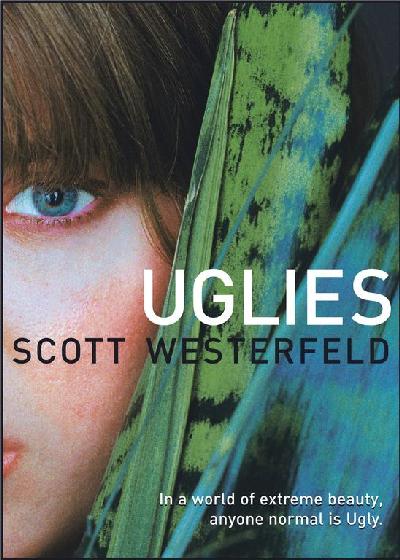
Review: Uglies by Scott Westerfeld


Description from Goodreads:

Tally is about to turn sixteen, and she can't wait. Not for her license—for turning pretty. In Tally's world, your sixteenth birthday brings an operation that turns you from a repellent ugly into a stunningly attractive pretty and catapults you into a high-tech paradise where your only job is to have a really great time. In just a few weeks Tally will be there.

But Tally's new friend Shay isn't sure she wants to be pretty. She'd rather risk life on the outside. When Shay runs away, Tally learns about a whole new side of the pretty world—and it isn't very pretty. The authorities offer Tally the worst choice she can imagine: find her friend and turn her in, or never turn pretty at all. The choice Tally makes changes her world forever.

Review:

I highly enjoyed Uglies by Scott Westerfeld. This is the first in a series: Uglies, Pretties, Specials and Extras. At first, I was sceptical about the book as the blurb did it little justice- I got the impression that it was about teenagers partying day and night. However, Uglies tackled some very difficult yet important issues such as the definition of beauty, friendship, acceptance and ethics in an innovative way.

As Tally, the main character, moves from the city into the wild, her mind expands, freed of the confines of the doctrines of the city. She realises that there is more to life than being ‘pretty’. Tally found out that there is more to people than just their outward appearance. This road to self-discovery was interesting to observe.

Tally Youngblood was a strong character who was easy to relate to. I was constantly aware of her thoughts and feelings (which is what I like in a book). Though Tally was strong, she still had her own vulnerabilities which she had to overcome.

Tally had to weigh her own wish for becoming a ‘pretty’ against the wishes of her own friends; not to betray them. She had to discover what was most important to her. This made her human and a complex, 3D character. The romance in Uglies was realistic, not overly done and served a purpose in the book. I liked that Tally’s character didn’t change so much after the start of her romantic relationship.

There was a solid image in my mind of Tally’s world which Westerfeld artfully created. Though the city’s name remained anonymous, a real sense of place was established. I liked the rules and boundaries that were developed. Westerfeld thought up some interesting, futuristic gadgets such as hoverboards, bungee jackets and interface rings, to mention just a few, which encapsulate the freedoms and restrictions of Tally’s life.

Uglies contained some complex relationships full of emotional turmoil which is always relevant in any era. Readers of any age can relate to this story and take something away from it. As in most dystopian novels, Uglies does have a moral message; however, it is not over-emphasised. In this case, the book addresses the ever- present need to conserve and protect the Earth or risk destroying both it and civilisation itself. This book is especially relevant for today’s society with the overwhelming obsession for fashion, cosmetic surgery and the desire to fit in whilst remaining unique.

Overall, Uglies was well-paced and I didn’t lose interest. I do believe that more time should have been spent at ‘The Smoke’ so that we could gain a better understanding of their lifestyle. The book was very descriptive; Westerfeld provided enough detail about the society in which Tally lived. Uglies was easy to read and understand and I would recommend it to other people. I was very impatient to get my hands on the next book. This is one of my favourite books that I’ve read this year and one of my favourite dystopian books.
Look out for my review of Pretties coming soon!

Cover: 5/5

Concept: 5/5

Rating: 5/5

Author: Scott Westerfeld

I wrote this review as part of Dystopian August over at Presenting Lenore. Check it out!

Review: Shade's Children by Garth Nix


Blurb from Amazon:

The clock is ticking for the children of the world, and the key to survival rests in the hands of Shade's Children. In a futuristic urban wasteland, evil Overlords have decreed that no child shall live a day past his fourteenth birthday. On that Sad Birthday, the child is the object of an obscene harvest resulting in the construction of a machinelike creature whose sole purpose is to kill. The mysterious Shade - once a man, but now more like the machines he fights - recruits the few children fortunate enough to escape. With luck, cunning, and skill, four of Shade's children come closer than any to discovering the source of the Overlords' power - and the key to their downfall. But the closer the children get, the more ruthless Shade seems to become!

Review:

Shade’s Children had an interesting storyline and had great potential. I was gripped by the fact that the main character at the beginning of the book, Goldeye, was in a life-threatening position and about to be caught by mutants. I was interested in the children’s Change talents and wondered how they had developed these abilities. Also, I wanted to know why they only lived until the age of fourteen- which I found out the answer to later on in the book.

However, the lack of emotional development of the characters limited the depth the story could have reached. The lack of emotional development meant that I was not able to form emotional attachments to the characters and thus, I did not sympathise with them very deeply.

There were some unanswered questions in the novel such as whether the adults who disappeared at the time of the ‘Change’ ever reappeared when the Grand Projector was destroyed. It was very unrealistic how Shade’s children were still obtaining supplies from supermarkets and stores all over the city, fifteen years after ‘The Change’. Surely all of the food would have perished or been taken by everyone else?

Also, the Overlords (the foe) were 2D. They did not explain their reasons for taking over the world and endlessly fighting pointless ceremonial battles. Like in most dystopian novels, the question of what had happened to the rest of the world remained unanswered. Shade’s Children was limited to the city and the immediate area around it. This meant that the book was unclear in some major areas.

The Overlords felt like secondary characters and I wanted them to be more three dimensional. I believe Shade’s Children would have ranked more highly with me if a deeper emotional layer was added to the novel. There were seven Overlords and they were all easily forgettable.

Whilst reading Shade’s Children, I felt like I was reading about a computer game. The action was playing out in front of me, one thing constantly after another, but I was adamantly not allowed into the characters’ minds; their thoughts and feelings. This left me feeling like an outsider and also wondering when these characters slept.

The extracts from the computer archives that were liberally interspersed throughout the book became wearisome after the first ten or so. These ranged from easily understandable character interviews to complex tables of figures and statistics (which I could have done without).

Shade, as a character, felt as if he could have been developed more. I actually liked the fact that I wasn’t sure whose side he was on throughout the book as it kept me guessing. Shade’s internal conflict was aptly demonstrated.

There were moments in Shade’s Children where I did empathise with the characters, but they were few and far between. For example, I felt emotional at the end of the book due to Ella and Drum’s heroism and I felt sorry for Shade’s victims.

Overall, I feel that Shade’s Children was an average story and I persevered to the end, even though I felt like giving up much earlier. I know that this book would appeal to people looking for loads of action without much of the emotional drama but Shade’s Children was not one of my favourites.

I would give Shade's Children a 3/5 stars.

Find more books by Garth Nix here.

Have you read Shade's Children? What did you think?

I am writing this review as part of Dystopian August over at Presenting Lenore. Go and check it out!

Monday, 9 August 2010

Review: The Knife of Never Letting Go by Patrick Ness

Summary and author bio from Amazon

Imagine you're the only boy in a town of men. And you can hear everything they think. And they can hear everything you think. Imagine you don't fit in with their plans... Todd Hewitt is just one month away from the birthday that will make him a man. But his town has been keeping secrets from him. Secrets that are going to force him to run...

Patrick Ness is the author of two critically acclaimed works of fiction, The Crash of Hennington and Topics About Which I Know Nothing. An award-winning novelist, he has also written for Radio 4, the Sunday Telegraph and is currently a literary critic for the Guardian. This is his first book for young adults.


Review:

The Knife of Never Letting Go: The Most Disappointing Book I’ve Read This Year

At first, I thought that The Knife of Never Letting Go had potential with the intriguing way in which the inhabitants of Prentisstown lived with the ‘Noise’-their unstoppable telepathic abilities and I was very curious to learn more about why there was an absence of women.

Ness’s writing style was very unique and descriptive. The long passages describing the terrain created a nice visual picture in my mind. After a while, Todd’s repetition and use of slang was extremely wearing on the nerves. I believe that if the repetition was cut out, it would reduce a third of the book without taking away anything from the content. Additionally, this means that the book was slow paced.
Another reason that I felt that the book was sluggish to read was because Todd and Viola were fleeing and on the road for most of the book rather than in the centre of the action (which is where I like the main characters to be). This was really frustrating. I felt like I was hearing about what was going on elsewhere only through secondary characters and not through Todd and Viola’s own accounts.

In regards to the characters, I liked Todd at the beginning of the book as he did have a unique voice; however, his repetition, ignorance and stubbornness let him down as the story wore on. I found Todd to be narrow-minded and uneducated. He wouldn’t let anyone help him even though he needed all the help he could get. I was expecting a lot from Viola as she was, for the most part, the only female character that we were acquainted with and I liked her slightly better than Todd.

A lot of importance was placed on Todd’s Ma’s book and it made me believe that all my questions would be answered-however this did not transpire. By the time that Todd got over his pride and let Viola read his Ma’s book (he couldn’t read it himself because he was illiterate) only one or two of the numerous questions that I had were answered and I did not believe this was a sufficient reward for my patient reading.

The women in Prentiss Town could read the telepathic thoughts of the men, however the men could not perceive the thoughts of the women. Why didn’t the women escape before they were killed if they could read the men’s thoughts? Wouldn’t they have heard the build up of the sinister thoughts? Ness has not answered these questions in the book and it left me feeling cheated. This was only one example of a stream of unanswered questions in The Knife of Never Letting Go.

The only time Todd and Viola met an original inhabitant of New World was when Todd killed one and that did not leave much time for a conversation-orally or telepathically. Ness missed a vital opportunity here for letting us learn more about the natives.

A lot of the time, suspense was heavily built up but no answers were delivered within the framework of the book which often left me feeling exasperated and frustrated. For example, the ending left much to be desired as it was anticlimactic after the high expectations of a large scale battle in a city- this ‘battle’ ended before it even began.

There were elements in the book that were not realistic. An example is that Viola was sent on a scout ship with her parents to survey the planet for viable settlements and to establish a base camp for the mother ship they came from which housed thousands of people. I find it highly unlikely that only two adults and a child would be sent to prepare a colony when thousands of lives depend on their success.

A major irritation in the novel was that characters that I thought were incontrovertibly dead from horrific injuries kept jumping up again-their injuries not slowing them down at all. This was very unrealistic and it was left unexplained. Most of all, it was comical. I don’t think that was what Ness was aiming for in this mostly dark story. Characters such as Aaron and Mr Prentiss Junior were human, just like Todd and Viola, although they seemed to demonstrate superhuman abilities- like rising from the dead!

Overall, while I felt The Knife of Never Letting Go had potential, I did not like this book at all as it left me thoroughly frustrated by the end of it and I will not be reading the next book, The Ask and The Answer.

Rating: 2/5


I am reviewing this as part of Dystopian August which is going on at Presenting Lenore

Tuesday, 13 July 2010

Review-Memoirs of a Teenage Amnesiac by Gabrielle Zevin


Paperback: 288 pages. /Published: Sep 2007
Why did I read this? I read Memoirs of a Teenage Amnesiac by Gabrielle Zevin a few months back. I was looking for a nice, young adult book. In contrast to the sad title, the front cover was colourful and bright enough for me to want to pick it up. More importantly, I was very curious as to how a person who lost their memory would deal with it.
-
Summary: After a fall down the front steps of her school Naomi forgets the last three and a half years of her life. She must re-discover the fact that she has a best friend, that she has a boyfriend and that her parents are divorced-she even has a half sister. Essentially, she has to find out who she was and who she is. Naomi finds out that she has changed. On the way to discovering the last three and a half years of her life, she realises that she isn't the same person anymore. Memoirs of a Teenage Amnesiac is about loss, love, family and most importantly, the journey to finding your own identity.
-
Strengths: I liked the sad tone of the book. I liked the easy and companionable friendship between Naomi and her best friend 'Coach'. Also, I enjoyed the relationship between Naomi and James-just another person trying to find his identity. The last scene between Naomi and James was one of the more memorable and emotional scenes.
-
Weaknesses: At times, I felt the pace of the story was slow and some scenes could have been cut out to stop repitition. Also, at the beginning, Naomi's reaction to her loss of memory seemed somewhat too calm for someone who has just lost their memory.
-
Cover: I like this cover more than the other cover for the book. It's light, summery and relates well to the book-music is important in the book.
-
Recommend: I would recommend this book.

Rating: 4/5


Lookie! They're making a movie for it!

http://www.youtube.com/watch?v=5_g0YseGHYU