Tuesday, 31 August 2010

September Spectacular Reading Challenge and Giveaway

ss

I'm taking the challenge (hopefully).

How does it work:

•It will start September 1st and go on through September 30th.

•There will be a 5 book reading challenge, ( one book a week) that you will have to read. Which books? Any 5 you want. It's your choice... Easy huh. At the end of that week you will post your review on your blog and add your link to the Mr. Linky at the bottom. ( If you don't have a blog you can either post a comment, letting everyone know what you think about the book or sent me an email with your review) * Sep first starts on a Wednesday so you can start your first book on Sunday the 29th if you want.

•At the end of each week a giveaway will be posted. That's 5 giveaways!! The only thing you have to do to enter is, link your review on that weeks Mr. Linky. Plus get an extra entry if you add the September Spectacular button to your post or sidebar! ( Open Internationally)---Info taken from The Thoughts of a Book Junky.

Want to take part? Click here.

My five books will be: (Subject to change)

Mockingjay by Suzanne Collins
The Clockwork Angel by Cassandra Clare
Poison Study by Maria V Snyder
Shiver by Maggie Stiefvater
and
Matched by Allie Condie

Review: Catching Fire By Suzanne Collins


Summary from Goodreads:

Against all odds, Katniss Everdeen has won the annual Hunger Games with fellow district tribute Peeta Mellark. But it was a victory won by defiance of the Capitol and their harsh rules. Katniss and Peeta should be happy. After all, they have just won for themselves and their families a life of safety and plenty. But there are rumors of rebellion among the subjects, and Katniss and Peeta, to their horror, are the faces of that rebellion. The Capitol is angry. The Capitol wants revenge.

Review:

Catching Fire is an excellent sequel to The Hunger Games as it explores the consequences of defying a vengeful, totalitarian regime. The readers are given a chance to view the eleven other districts quite briefly. More time could have been spent on exploring them in detail as I was very interested in learning more about the geography and culture of Panem.

When I found at that Katniss and Peeta were forced to enter the arena again, I was quite annoyed as I thought it would be a repetition of the first book. However, different events occurred this time around which made it exciting. Catching Fire delved more into the supposedly luxury lifestyles of the Capitol’s citizens.

Despite their exquisite lifestyle, abundant food and wacky body alterations, they are just as oppressed as the people of the Districts in their own way. This was most appallingly demonstrated by the way in which Capitol partygoers would take purging drinks after over-indulging in food so that they could carry on eating. They also spend their time carrying out different types of body surgery and trying out new hairstyles due to their boredom.

I liked the fact that new characters were introduced, such as Champions from previous years, as it added a different aspect to the impact of the Hunger Games. Catching Fire showed the growing unrest among the greater population which was good.

Collins did not shy from illustrating the brutality of the regime with a graphical description of the way in which a man was so casually executed for whistling and the way in which Gale was mercilessly whipped for hunting for food.

In addition, more light was shed upon Haymitch’s intriguing past which I was eager to learn about as it explained why he became the way he is (a drunkard). Although Catching Fire was really good, Collins failed to show how Katniss’ mother and sister dealt with losing her for a second time when they were all so certain that she was safe as a Champion, as it must have been devastating.

Although the book did contain violence, it also had deeply moving scenes which demonstrated self sacrifice for the sake of love. These scenes made me extremely sad but I am glad that they were included as it shows that the characters can think about more than just their own survival and the power of love.

The romance thread still continued in this book and has not yet been resolved. The presence of romance adds to the feel of the story but will hopefully be resolved in the next book to the satisfaction of the majority. The novel was well-paced and the characters were well-developed although more time could have been spent in showcasing the Districts.

I really enjoyed Catching Fire and eagerly read the whole book. It’s exciting, gripping and unputdownable. I would recommend this trilogy to everyone.

Book Rating: 5/5

Cover: 5/5

Concept: 5/5

I wrote this review as part of Dystopian August which is taking place over at Presenting Lenore. Check it out!

Review: The Declaration by Gemma Malley


Summary from Goodreads:

In the year 2140, it is illegal to be young.

Children are all but extinct.

The world is a better place.

Longevity drugs are a fountain of youth. Sign the Declaration, agree not to have children and you too can live forever. Refuse, and you will live as an outcast. For the children born outside the law, it only gets worse – Surplus status.

Not everyone thinks Longevity is a good thing, but you better be clear what side you’re on. . . . Surplus Anna is about to find out what happens when you can’t decide if you should cheat the law or cheat death.

Review:

The Declaration was a great, dystopian novel which offered valuable insight to what would happen if people could live longer-centuries longer. Malley’s writing style was easy to understand, non-convoluted and always included me, the reader. In short, I enjoyed her writing and the concept of the story.

At first, I didn’t like Anna because I knew that her writing everything down in her journal and hiding it away would lead to trouble for her. I knew she would be caught. However, as time passed and she became less stubborn and more accepting towards Peter, I liked her slightly more. For the most part, Anna was a good character.

Anna was known as 'Surplus Anna' in the Surplus hall where she lived. Her life's aim was to be a good Surplus, so she can go out and serve a 'Legal'. She was made to feel lower than low.

Peter was an interesting character and throughout the novel, I didn’t know whether I could trust him or not (much like Anna). I liked that Peter kept me guessing as to his true loyalties as it made the story much more interesting. Peter felt like a wonderful contrast to Anna-he was much more rebellious while she was much more rule-abiding, owing to the way she was brought up.

The plot was mostly fast-paced for which I was glad. Anna’s road to discovery was interesting to observe and I felt sorry for what had happened to her and those like her at the hands of greedy adults.

Mrs Pincent was the most horrible, evil character I came across and I was happy with what happened to her in the end. However, this was tinged with a slight sadness at what others had done to her. The more my hate grew for her, the more sympathy I felt for both Peter and Anna.

The ending was very rushed-all the concluding events occurred in a rush. Anna only knew her parents for a few days before they killed themselves to make her and her young brother ‘legal’. Her parents weren’t that well-developed as characters for me to have felt sorry for them.

The savagery of what Anna's parents had to do in contrast to what a civilised society everyone else thought themselves to be living in really shocked me. As a young person myself, I felt very sad about what happened in this book, but know that it could be a very real possibility one day.

Overall, The Declaration was well executed and I enjoyed it. The novel asks questions that society may be afraid to answer. What would we do if we could all live hundreds of years longer? Would we still have children? And if so, what would we do with them? In this age of constantly developing science, it may not be too long before we really do have to answer these questions.

I really enjoyed The Declaration and was eager to read the next book, The Resistance.

Book Rating: 4/5

Cover: 4/5

Concept: 5/5

Author: Gemma Malley

I wrote this review as part of Dystopian August which is taking place at Presenting Lenore.

Sunday, 29 August 2010

Review: The People of Sparks


*Second Book in the series*

Summary from Goodreads:

The People of Sparks picks up where The City of Ember leaves off. Lina and Doon have emerged from the underground city to the exciting new world above, and it isn’t long before they are followed by the other inhabitants of Ember. The Emberites soon come across a town where they are welcomed, fed, and given places to sleep. But the town’s resources are limited and it isn’t long before resentment begins to grow between the two groups. When anonymous acts of vandalism push them toward violence, it’s up to Lina and Doon to discover who’s behind the vandalism and why, before it’s too late.

Review:

The People of Sparks is the post-apocalyptic continuation of the first in the series, The City of Ember. I highly enjoyed The People of Sparks as I really wanted to know what happened to the Emberites after they left their underground home and this book began where the first book left off and for that I was glad as I didn’t miss anything.

Lina and Doon remained strong, independent characters. In this book, they seemed to have their own journeys to take and they grew in different ways. This was different than the first book as Lina and Doon figured more of the mystery out together, but in this book, they were physically apart for longer lengths of time. I missed them working together. Also, I figured out the mystery of who was causing strife between the two groups before it was discovered in the book.

Of course, all the Emberites had to acclimatise to their new surroundings and I believe that DuPrau achieved this realistically. They slowly learnt to live on the surface of the world and tried to get along with the people of Sparks, with mostly negative results- until the end.

The new characters, the people of Sparks, were well written and 3D. They acted in ways that I would have expected them to so the story was believable. There seemed to be a lull in the middle of the story and I was waiting for it to pick up. Luckily, it did and the climax of the book was somewhat exciting and resolved nicely. The ending, like the first book, was exciting and filled me with hope as to what would come next.

I liked the message of The People of Sparks. I think the book asks us to all work together and put aside our differences (Not working together will just lead to discord). All the themes, such as learning, friendship, the idea of community and oneness were interesting to observe in The People of Sparks.

Overall, while I enjoyed The People of Sparks, I didn’t feel as though it was as good as it could have been and it wasn’t as good as The City of Ember. However, Lina and Doon did mature and develop as characters and it was exciting to watch them learn about the world.

DuPrau’s style of writing was mostly engaging. The book was good; it ended in such a way that it made me want to know what would happen next. After this, DuPrau wrote The Prophet of Yonwood, the third Book of Ember, which was a prequel to the series and The Diamond of Darkhold, the fourth book which shows what happened to the People of Ember next.

Although I have read The Prophet of Yonwood, I have not read The Diamond of Darkhold yet.

Book Rating: 4/5

Cover: 5/5

Concept: 3.5/5

Author: Jeanne DuPrau

I wrote this review as part of Dystopian August which is going on over at Presenting Lenore. Check it out.

Review: The City of Ember by Jeanne DuPrau


The City of Ember: The Ember series, Book 1

Summary from Goodreads:

The city of Ember was built as a last refuge for the human race. Two hundred years later, the great lamps that light the city are beginning to flicker. When Lina finds part of an ancient message, she’s sure it holds a secret that will save the city. She and her friend Doon must decipher the message before the lights go out on Ember forever! This stunning debut novel offers refreshingly clear writing and fascinating, original characters.

Review:

The City of Ember is fantastic. This novel was one of the first books that I read that got me interested in the dystopian/post-apocalyptic genre. The first time I read it I loved it. The idea of an entire society living underground (unbeknownst to them) captivated me. What would they eat? What did they look like? Did they have any knowledge of the outside world? These were questions that ran through my head.

I had many questions on how a society would live like this and they were all answered in the book. The City of Ember was a page turner and didn't disappoint. I constantly wanted to know what was going to happen next and I couldn’t put it down, so I read well into the early hours of the morning.

Lina and Doon were great characters who were in the centre of the action at all times. They were inquisitive, brave and I was able to sympathise with them. When I first read The City of Ember (around the age of fifteen or sixteen) I admired these characters a lot. However, after recently re-reading the book, I realised that I would like more character depth. While DuPrau was very good at characterising Lina and Doon to make them appealing to readers, I would have liked to understand their thoughts and feelings more.

The City of Ember is in the third person and follows the two main characters, Lina and Doon as they try to save their flagging city. I enjoyed the visual descriptions of the city of Ember, however I would have liked more. There were parts of the book that were very sad (such as when the lengths some citizens went to discover what was outside of the city). Working out the clues was also really fun and I appreciated the fact that Lina and Doon worked it out in time.

The pace of the book was great. I didn’t feel bored at all. There were some minor side-stories that became integrated into the main plot so everything in the book fit. One of my favourite parts would have to be the ending which set up the scene perfectly for the next book. The ending was emotional, visual and memorable. I felt sorry for the characters as they didn't know they were living underground and that the world had undergone a disaster.

Overall, The City of Ember was an excellent book that I was very glad to have read. It offered an interesting perspective of what could happen after a worldwide disaster. The characters were rounded and smart.

I believe that the novel can be enjoyed by readers of all ages. A movie has been made of The City of Ember. I liked the movie as it stayed mostly true to the novel. After I read The City of Ember, I was very keen to read the sequel, The People of Sparks. Look out for my review of the sequel coming soon!

Book Rating: 4.5/5

Cover: 5/5

Concept: 5/5

Author: Jeanne DuPrau

I wrote this review as part of Dystopian August which is going on over at Presenting Lenore. Check it out!

Saturday, 28 August 2010

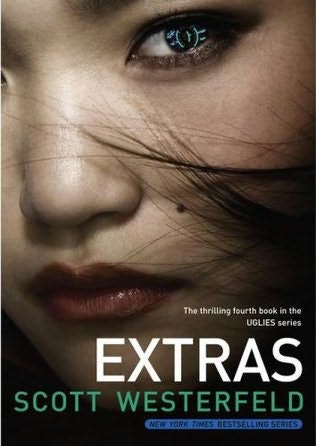
Review: Extras by Scott Westerfeld


This is the fourth book in the series.


Reading Order: Uglies, Pretties, Specials and Extras, Bogus to Bubbly:An Insider's Guide to the World of Uglies and Mind-Rain: Your Favorite Authors on Scott Westerfeld's Uglies Series .

Summary from Goodreads:

It's a few years after rebel Tally Youngblood took down the uglies/pretties/specials regime. Without those strict roles and rules, the world is in a complete cultural renaissance. "Tech-heads" flaunt their latest gadgets, "kickers" spread gossip and trends, and "surge monkeys" are hooked on extreme plastic surgery. And it's all monitored on a bazillion different cameras. The world is like a gigantic game of American Idol. Whoever is getting the most buzz gets the most votes. Popularity rules.

As if being fifteen doesn't suck enough, Aya Fuse's rank of 451,369 is so low, she's a total nobody. An extra. But that's just until she gets to kick a good story for herself.

Then Aya meets a clique of girls who pull crazy tricks, yet are deeply secretive of it. Aya wants desperately to kick their story, to show everyone how intensely cool the Sly Girls are. But doing so would propel her out of extra-land and into the world of fame, celebrity...and extreme danger. A world she's not prepared for.

Review:

Extras was a fantastic book. I really enjoyed it. It didn’t let the series down; it was a great addition to the Uglies series. I really appreciated the fact that it was from a new character’s point of view because it was interesting to get a wider and more varied perspective. During the book, events were sometimes viewed from the perspective of Aya’s hovercam, Moggle, which added a new slant to the action.

Extras is set three years after the happenings of Specials and thus, I was able to observe the changes wrought by the cure for ‘prettymindedness’.

Whereas in the earlier three books where Westerfeld focussed on beauty, in Extras the focus was on gaining popularity and a higher reputation. Also, it was set in an unspecified city in Japan which made a change and illustrated to readers the extent that prettymindedness had travelled prior to the cure.

The characters were well rounded, 3-D and had real aspirations that people in our society have. Extras reflects the lengths that people in our society will go to for recognition. It was exciting to watch Aya’s struggle to attain fame and eminence.

Westerfeld’s descriptions were very imaginative, especially of strange body alterations. The themes of the novel were self worth in conjunction with society’s view of an individual. Extras was fast-paced and kept me enthralled. I loved the plot of the story and was surprised by the twists and turns in the novel. I was pleasantly surprised as to the deeper meaning of what it meant to be an 'Extra'.

As expected, Westerfeld thought up some super new technology to be integrated into the futuristic society and to fascinate readers. These new technological advancements included hoverball rigs, hovercams, mag-lev trains and radical honesty surgery among many other weird and wonderful inventions.

As Extras was narrated from a different viewpoint, Tally, the main character from the previous books, came across as harsh, cold and distant. This wasn’t the Tally I was used to as I wasn’t privy to her thoughts. Perhaps it would have been better if Aya had overheard a conversation or two where Tally related her thoughts, feelings and apprehensions about her new role as the enforcer of the conservation of the world.

In addition, Shay and David seemed very out of character and insignificant in comparison to their prior roles in the Uglies series. David only had a few sentences in the whole book and Shay, although disapproving of Tally’s rash behaviour, was placed in a subordinate role, rather than as an equal to Tally such as in the previous books. This may have been because Tally was now the only fully-equipped Special. Nevertheless, it was strange to observe.

One of the major aspects of the story was Aya’s journalistic ambitions and Westerfeld placed great emphasis on reprimanding Aya when she published an inaccurate article about a city-destroying weapon. This shows that people should be sure of their facts before circulating them as scandalous news such as that can result in disastrous consequences. However, as in all good stories, Aya was able to redeem the situation by finding out the truth just in time.

Overall, Extras was awesome and I am very, very glad I read it. Aya’s point of view was refreshing, unique and enjoyable to read about. The society I was introduced to was impressively-depicted and I could visualise the story in my mind’s eye. I was sad to finish the series. Extras is a must read.

I am hoping for another book from Westerfeld for this series. While Extras ended the series very well, I feel that there is more Westerfeld could explore in further novels. There is a guide to this series called Bogus to Bubbly which I will look into and also Mind Rain. I will also check out his other books. There is also a movie being planned for Uglies in 2011 so look out for that.

Uglies Series in Order of My Satisfaction Level:

Uglies

Extras

Pretties

Specials


Book Rating: 5/5

Cover: 5/5

Concept: 5/5

Author: Scott Westerfeld

I reviewed Extras as part of Dystopian August which is going on over at Presenting Lenore. Check it out!

Friday, 27 August 2010

Mockingjay Cover Remake for The Unread Reader's Contest

The Unread Reader is holding a contest where you have to remake/recreate the Mockingjay cover for your chance to win The Hunger Games Box Set (0r any box set/ books eqivalent or below the value of The Hunger Games Box Set. So even if you own The Hunger Games, you can still enter and win something else! Awesome, right?)

The contest is international!

Click here for details

Make sure you recreate the Mockingjay cover, not the other two or they won't be counted!

Here's my entry:


What do you think? Yay or or an all round nay?

Wednesday, 25 August 2010

Review: Specials by Scott Westerfeld


Summary from Goodreads:
"Special Circumstances":

The words have sent chills down Tally's spine since her days as a repellent, rebellious ugly. Back then Specials were a sinister rumor -- frighteningly beautiful, dangerously strong, breathtakingly fast. Ordinary pretties might live their whole lives without meeting a Special. But Tally's never been ordinary.


And now she's been turned into one of them: a superamped fighting machine, engineered to keep the uglies down and the pretties stupid.


The strength, the speed, and the clarity and focus of her thinking feel better than anything Tally can remember. Most of the time. One tiny corner of her heart still remembers something more.


Still, it's easy to tune that out -- until Tally's offered a chance to stamp out the rebels of the New Smoke permanently. It all comes down to one last choice: listen to that tiny, faint heartbeat, or carry out the mission she's programmed to complete. Either way, Tally's world will never be the same.

*SPOILERS AHEAD*

Review:

Specials was quite a good sequel to Pretties as it explained in detail what being a Special actually felt like. Prior to this, Specials were mysterious and terrifying. Like in previous books, Specials continued the process of exploring personal relationships. It also looked into how becoming a superhuman would affect a relationship.

Westerfeld successfully developed the main characters. However, the secondary characters seemed quite 2D and could have been developed more, for example, Tachs, Ho and many of the other Cutters.

Some parts of the book were slow such as the beginning, whereas other parts were comparatively fast-paced. The author introduced new vocabulary such as ‘icy’ and ‘Randoms’ which showed the Cutters’ perception of the world.

In Pretties, Tally had to rediscover her true memories. In Specials, her memories about the past were inaccurate and twisted which meant she had to rediscover her memories once again which made the book repetitive for readers.

The abrupt changes in the relationship between Tally and Shay throughout the series, but especially noticeable in Specials, was tiresome as they went from being the best of friends to the worst of enemies and to being allies again. Shay’s outbursts of fury towards Tally felt like déjàvu from Pretties and Uglies.

As in previous books, Westerfeld introduced interesting technology such as sneak suits, shock sticks and deadly, all consuming nanos to show the technological advancement of Tally’s society. The sneak suits were especially fascinating as they could change both texture and colour. They could mimic any garment, provide armour and disguise heat.

The last few chapters were written hastily and felt like an epilogue. Tally was removed from the centre of action and saw events unfold from the confines of her prison cell. Westerfeld no doubt intended Tally to have some time to think over her experiences and rewire her brain. Being unable to act meant that she had plenty of time to think.

Also, the ending felt rushed. For someone she loved, Tally did not spend much time mourning Zane’s death. It was less than five minutes. Also, Dr Cable’s sudden change of heart in rescuing Tally at the end of the book was out of character to all that she had done previously. It would have been better if Tally had escaped herself or if someone else rescued her. This would have been more believable.

Personally, I didn’t agree with Tally’s decision to remain a Special as one can only rewire oneself to a certain extent and battling with bursts of intense fury and feelings of superiority could very easily lead to disaster due to her superhuman strength.

Overall, Specials was okay, but not the best out of the series. It was definitely worth reading. Though I stopped reading it once in the middle of the book, I picked it up again and finished reading to the end.

At this point, I wasn’t sure what Extras (the next book) was about, but I hoped it would shed some light as to what had happened to Tally next and what had happened to society after the cure.


Book Rating: 3/5

Cover: Very special;)

Concept: 4/5

Author: Scott Westerfeld

I wrote this review as part of Dystopian August which is going on over at Presenting Lenore. Check it out!

Leilani and Dija's Recreate a Cover Contest

Over at Leilani Loves Books, Leilani and Dija (from Black Fingernailed Reviews) are having a recreate a cover contest which runs from August 16th to September 30th. Also, there is an easier contest where you only need to fill in a form, so head on over there, check it out and enter.

I chose to recreate both the covers. Here's my entries:

Rotters by Daniel Kraus


I chose this pic because I think it symbolises something that is very sacred in graveyards and I wanted to depict that on the cover. I wanted the title to be bright and eye-catching.

and

Wake Unto Me by Lisa Cach


Well, I love this one too. Purple is actually my favourite colour so I had to use it. I like how it looks like she's calling her soulmate-a ghost- to her.

Monday, 23 August 2010

Hunger Games Recreated Cover

I cannot wait to read Mockingjay.

Here's a cover I made for The Hunger Games!


Enter The Unread Reader's Recreate a Cover contest for The Hunger Games Box Set here. International.

Thursday, 19 August 2010

Review: Pretties by Scott Westerfeld


Reading Order: Uglies, Pretties, Specials and Extras (companion novel).

--

This review contains spoilers if you haven't read Uglies. You can read my review of Uglies here.

--

Summary from Goodreads:

Tally has finally become pretty. Now her looks are beyond perfect, her clothes are awesome, her boyfriend is totally hot, and she's completely popular. It's everything she's ever wanted.

But beneath all the fun -- the nonstop parties, the high-tech luxury, the total freedom -- is a nagging sense that something's wrong. Something important. Then a message from Tally's ugly past arrives. Reading it, Tally remembers what's wrong with pretty life, and the fun stops cold.

Now she has to choose between fighting to forget what she knows and fighting for her life -- because the authorities don't intend to let anyone with this information survive.


Review:

Pretties is the second book in the Uglies Trilogy and has just as many twists and turns as Uglies. It riveted my attention and was a page-turner. The beginning was very interesting as Tally’s perception had vastly changed as she had undergone the ‘Pretty’ operation.

The book is mainly about the way in which she rediscovers her own mind, feelings and identity. Also, Tally had to work out her feelings for David and Zane; her old boyfriend and her new boyfriend.

In the novel, Westerfeld expanded on the various types of technology that were present in Tally’s society which I found fascinating. The author created new vocabulary such as ‘bubbly’, ‘bogus’ and ‘dizzy-making’- the terms were utilised in a different context to their normal use and it added an element of authenticity to the narrative; however I wasn’t informed about what some of the terms meant such as the significance of the added ‘wa’ in ‘Tally-wa’ and the ‘la’ added to the end of Zane and Shay’s names- this was rather irritating.

The book was good at keeping my attention. Even though Tally had been turned ‘Pretty’, she still showed signs of her ‘Ugly’ mind at the beginning of the novel. Tally was more alert than the average ‘pretty’ in her thought processes and reasoning. This was necessary to keep the story from stultifying or coming to a complete standstill. Tally’s rediscovering of facts that the reader already knew from Uglies did not feel too slow or too fast which was good; otherwise it would have put me off from reading any further.

However, after her close escape from the city, when Tally found herself in an experimental zone inhabited by primitive Uglies, the book seemed to go off on a tangent. This portion of the book felt quite separate from the main action. I can understand why Westerfeld felt the need to include the sufferings of the people at the hands of the city, but it wasn’t cohesive and was tenuously linked to the main action.

In addition, Tally’s so-called best friend from Ugly days, came across as very 2D and was extremely disappointing after being built up in the reader’s mind to be a more significant character than he actually was. He seemed to be replaced by Zane. Zane, although a complex and interesting character, was introduced very suddenly to make up for Peris’s deficiencies.

Furthermore, a major tragedy in Pretties was when Tally was given two pills which were meant to be the cure for pretty-mindedness. The pills were meant to be taken together, however this part of the novel was extremely unrealistic as the pills were sent from a doctor without instructions on how they should be taken.

This was discordant to the doctor’s previous conduct, where she insisted that Tally give informed consent. The fact that instructions weren’t given led to disastrous consequences which could have easily been avoided. I know that Westerfeld needed this to happen in the novel, however, it could have happened in a more realistic fashion.

This underplayed on the importance that doctors place upon the well-being of their patients. This was highly incompetent and frustrating to read about. This streak of irresponsible behaviour was further demonstrated when the doctor accused Tally of incompetence and stupidity when Tally was not in possession of all the facts.

Towards the end of the novel, Tally’s increasing obsession with blaming herself for everything that went wrong became highly wearisome. There is no problem with blaming herself when she was at fault, but to do so when events were out of her control was tedious for me as a reader.

Overall, Pretties, though not quite up to the par of Uglies, was an enjoyable sequel. I’m glad I read it and I would recommend this book to other people. After I finished Pretties, I was eager to read Specials; to see what would happen to Tally Youngblood next.

Book Rating: 4/5

Cover: I prefer the UK cover of Pretties.

Concept: 5/5

Author: Scott Westerfeld

I wrote this review as part of Dystopian August which is going on over at Presenting Lenore. Check it out!

Saturday, 14 August 2010

Book Review-Children of the Dust by Louise Lawrence


Summary from Goodreads:

The story begins on a May afternoon in England. The sirens wail and people panic - war has suddenly broken out between East and West and the bombs are falling. Very soon the war is over, and from that afternoon the world has changed forever...

Sarah's story is about what it is like right after the nuclear holocaust, with Sarah, her step mother, and her half brother and sister sealed inside a dark house, and dealing with the effects of the radioactive fallout.

"Ophelia" takes place a little later, in a bunker filled with people who have survived the holocaust. They try to maintain and uphold a civil society, and to prepare for the world that's waiting for them outside.

The third story, "Simon" takes place decades after the war and we see a new species of human has emerged as a result of the contaminated world.

~~~~~~~~~~~~~~~~~~~~~

Review:

I really enjoyed Children of the Dust by Louise Lawrence. I read this book years ago and it struck a chord with me. This was one of the first dystopian/post-apocalyptic novels I read and it was a great introduction into the genre. This novel makes you think very deeply about our world. Are we taking care of it? Will we really end up like this?

Lawrence has written a realistic, informative account of life after such a great disaster. Though Children of the Dust is quite dark and hope seems lost throughout much of the story, there were significant glimmers of humans recovering and progressing that it was enough for me to enjoy the book. Additionally, Children of the Dust ended on a very positive note and I was filled with hope for the future.

The story is narrated from three perspectives: Sarah, Ophelia and Simon-three very different characters that are intrinsically connected. This multiple-narration is something that I haven't observed in many dystopian books so I was very much enthralled. Instead of discovering the effects of this 'nuclear disaster' on only one generation, I was able to learn about three generations and thus know of the impacts in the long term.

Also, Lawrence has written the story in such a way that it was possible for me to sympathise with all three narrators. This had been an aspect I'd been worried about previous to reading the book, however, the multiple-narration did not affect me in developing emotional attachments with all three narrators. I liked the fact that Sarah, Ophelia and Simon all learnt and developed as characters. There were scenes where my heart was wrenching because of what the characters had to go through, for example, the innocence of William, Sarah's young brother, who did not understand what was happening.

My only qualm with Children of the Dust was that the reason for the supposed nuclear war was not obviously stated but only hinted at. I felt as though Lawrence was telling her readers: It is enough to know that it happened.

Overall, Children of the Dust was a highly enjoyable read that allowed me to delve into the minds of three generations of people affected by a nuclear disaster. I found the story very realistic and frightening in the possibility that it may happen one day. For me, Children of the Dust was an unforgettable tale about survival, family and hope.

Book Rating: 4.5/5 - Children of the Dust could have gone into more detail in some aspects.

Concept: 4/5 - I would have liked further depth in the story.

Cover: 4/5 - Very much in relation to the story, sad and poignant.

Extract from Children of the Dust.

I wrote this review as part of Dystopian August at Presenting Lenore. Check it out and take part!

Thursday, 12 August 2010

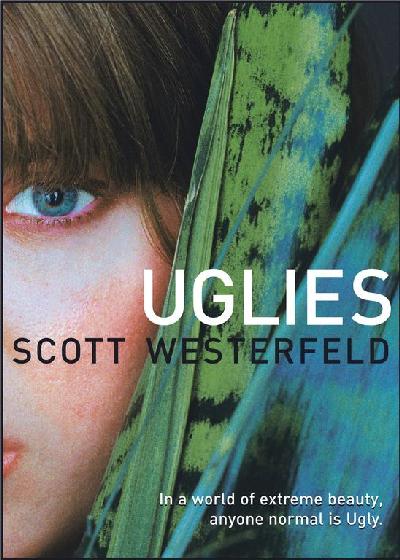
Review: Uglies by Scott Westerfeld


Description from Goodreads:

Tally is about to turn sixteen, and she can't wait. Not for her license—for turning pretty. In Tally's world, your sixteenth birthday brings an operation that turns you from a repellent ugly into a stunningly attractive pretty and catapults you into a high-tech paradise where your only job is to have a really great time. In just a few weeks Tally will be there.

But Tally's new friend Shay isn't sure she wants to be pretty. She'd rather risk life on the outside. When Shay runs away, Tally learns about a whole new side of the pretty world—and it isn't very pretty. The authorities offer Tally the worst choice she can imagine: find her friend and turn her in, or never turn pretty at all. The choice Tally makes changes her world forever.

Review:

I highly enjoyed Uglies by Scott Westerfeld. This is the first in a series: Uglies, Pretties, Specials and Extras. At first, I was sceptical about the book as the blurb did it little justice- I got the impression that it was about teenagers partying day and night. However, Uglies tackled some very difficult yet important issues such as the definition of beauty, friendship, acceptance and ethics in an innovative way.

As Tally, the main character, moves from the city into the wild, her mind expands, freed of the confines of the doctrines of the city. She realises that there is more to life than being ‘pretty’. Tally found out that there is more to people than just their outward appearance. This road to self-discovery was interesting to observe.

Tally Youngblood was a strong character who was easy to relate to. I was constantly aware of her thoughts and feelings (which is what I like in a book). Though Tally was strong, she still had her own vulnerabilities which she had to overcome.

Tally had to weigh her own wish for becoming a ‘pretty’ against the wishes of her own friends; not to betray them. She had to discover what was most important to her. This made her human and a complex, 3D character. The romance in Uglies was realistic, not overly done and served a purpose in the book. I liked that Tally’s character didn’t change so much after the start of her romantic relationship.

There was a solid image in my mind of Tally’s world which Westerfeld artfully created. Though the city’s name remained anonymous, a real sense of place was established. I liked the rules and boundaries that were developed. Westerfeld thought up some interesting, futuristic gadgets such as hoverboards, bungee jackets and interface rings, to mention just a few, which encapsulate the freedoms and restrictions of Tally’s life.

Uglies contained some complex relationships full of emotional turmoil which is always relevant in any era. Readers of any age can relate to this story and take something away from it. As in most dystopian novels, Uglies does have a moral message; however, it is not over-emphasised. In this case, the book addresses the ever- present need to conserve and protect the Earth or risk destroying both it and civilisation itself. This book is especially relevant for today’s society with the overwhelming obsession for fashion, cosmetic surgery and the desire to fit in whilst remaining unique.

Overall, Uglies was well-paced and I didn’t lose interest. I do believe that more time should have been spent at ‘The Smoke’ so that we could gain a better understanding of their lifestyle. The book was very descriptive; Westerfeld provided enough detail about the society in which Tally lived. Uglies was easy to read and understand and I would recommend it to other people. I was very impatient to get my hands on the next book. This is one of my favourite books that I’ve read this year and one of my favourite dystopian books.
Look out for my review of Pretties coming soon!

Cover: 5/5

Concept: 5/5

Rating: 5/5

Author: Scott Westerfeld

I wrote this review as part of Dystopian August over at Presenting Lenore. Check it out!

Review: Shade's Children by Garth Nix


Blurb from Amazon:

The clock is ticking for the children of the world, and the key to survival rests in the hands of Shade's Children. In a futuristic urban wasteland, evil Overlords have decreed that no child shall live a day past his fourteenth birthday. On that Sad Birthday, the child is the object of an obscene harvest resulting in the construction of a machinelike creature whose sole purpose is to kill. The mysterious Shade - once a man, but now more like the machines he fights - recruits the few children fortunate enough to escape. With luck, cunning, and skill, four of Shade's children come closer than any to discovering the source of the Overlords' power - and the key to their downfall. But the closer the children get, the more ruthless Shade seems to become!

Review:

Shade’s Children had an interesting storyline and had great potential. I was gripped by the fact that the main character at the beginning of the book, Goldeye, was in a life-threatening position and about to be caught by mutants. I was interested in the children’s Change talents and wondered how they had developed these abilities. Also, I wanted to know why they only lived until the age of fourteen- which I found out the answer to later on in the book.

However, the lack of emotional development of the characters limited the depth the story could have reached. The lack of emotional development meant that I was not able to form emotional attachments to the characters and thus, I did not sympathise with them very deeply.

There were some unanswered questions in the novel such as whether the adults who disappeared at the time of the ‘Change’ ever reappeared when the Grand Projector was destroyed. It was very unrealistic how Shade’s children were still obtaining supplies from supermarkets and stores all over the city, fifteen years after ‘The Change’. Surely all of the food would have perished or been taken by everyone else?

Also, the Overlords (the foe) were 2D. They did not explain their reasons for taking over the world and endlessly fighting pointless ceremonial battles. Like in most dystopian novels, the question of what had happened to the rest of the world remained unanswered. Shade’s Children was limited to the city and the immediate area around it. This meant that the book was unclear in some major areas.

The Overlords felt like secondary characters and I wanted them to be more three dimensional. I believe Shade’s Children would have ranked more highly with me if a deeper emotional layer was added to the novel. There were seven Overlords and they were all easily forgettable.

Whilst reading Shade’s Children, I felt like I was reading about a computer game. The action was playing out in front of me, one thing constantly after another, but I was adamantly not allowed into the characters’ minds; their thoughts and feelings. This left me feeling like an outsider and also wondering when these characters slept.

The extracts from the computer archives that were liberally interspersed throughout the book became wearisome after the first ten or so. These ranged from easily understandable character interviews to complex tables of figures and statistics (which I could have done without).

Shade, as a character, felt as if he could have been developed more. I actually liked the fact that I wasn’t sure whose side he was on throughout the book as it kept me guessing. Shade’s internal conflict was aptly demonstrated.

There were moments in Shade’s Children where I did empathise with the characters, but they were few and far between. For example, I felt emotional at the end of the book due to Ella and Drum’s heroism and I felt sorry for Shade’s victims.

Overall, I feel that Shade’s Children was an average story and I persevered to the end, even though I felt like giving up much earlier. I know that this book would appeal to people looking for loads of action without much of the emotional drama but Shade’s Children was not one of my favourites.

I would give Shade's Children a 3/5 stars.

Find more books by Garth Nix here.

Have you read Shade's Children? What did you think?

I am writing this review as part of Dystopian August over at Presenting Lenore. Go and check it out!

Monday, 9 August 2010

Review: The Knife of Never Letting Go by Patrick Ness

Summary and author bio from Amazon

Imagine you're the only boy in a town of men. And you can hear everything they think. And they can hear everything you think. Imagine you don't fit in with their plans... Todd Hewitt is just one month away from the birthday that will make him a man. But his town has been keeping secrets from him. Secrets that are going to force him to run...

Patrick Ness is the author of two critically acclaimed works of fiction, The Crash of Hennington and Topics About Which I Know Nothing. An award-winning novelist, he has also written for Radio 4, the Sunday Telegraph and is currently a literary critic for the Guardian. This is his first book for young adults.


Review:

The Knife of Never Letting Go: The Most Disappointing Book I’ve Read This Year

At first, I thought that The Knife of Never Letting Go had potential with the intriguing way in which the inhabitants of Prentisstown lived with the ‘Noise’-their unstoppable telepathic abilities and I was very curious to learn more about why there was an absence of women.

Ness’s writing style was very unique and descriptive. The long passages describing the terrain created a nice visual picture in my mind. After a while, Todd’s repetition and use of slang was extremely wearing on the nerves. I believe that if the repetition was cut out, it would reduce a third of the book without taking away anything from the content. Additionally, this means that the book was slow paced.
Another reason that I felt that the book was sluggish to read was because Todd and Viola were fleeing and on the road for most of the book rather than in the centre of the action (which is where I like the main characters to be). This was really frustrating. I felt like I was hearing about what was going on elsewhere only through secondary characters and not through Todd and Viola’s own accounts.

In regards to the characters, I liked Todd at the beginning of the book as he did have a unique voice; however, his repetition, ignorance and stubbornness let him down as the story wore on. I found Todd to be narrow-minded and uneducated. He wouldn’t let anyone help him even though he needed all the help he could get. I was expecting a lot from Viola as she was, for the most part, the only female character that we were acquainted with and I liked her slightly better than Todd.

A lot of importance was placed on Todd’s Ma’s book and it made me believe that all my questions would be answered-however this did not transpire. By the time that Todd got over his pride and let Viola read his Ma’s book (he couldn’t read it himself because he was illiterate) only one or two of the numerous questions that I had were answered and I did not believe this was a sufficient reward for my patient reading.

The women in Prentiss Town could read the telepathic thoughts of the men, however the men could not perceive the thoughts of the women. Why didn’t the women escape before they were killed if they could read the men’s thoughts? Wouldn’t they have heard the build up of the sinister thoughts? Ness has not answered these questions in the book and it left me feeling cheated. This was only one example of a stream of unanswered questions in The Knife of Never Letting Go.

The only time Todd and Viola met an original inhabitant of New World was when Todd killed one and that did not leave much time for a conversation-orally or telepathically. Ness missed a vital opportunity here for letting us learn more about the natives.

A lot of the time, suspense was heavily built up but no answers were delivered within the framework of the book which often left me feeling exasperated and frustrated. For example, the ending left much to be desired as it was anticlimactic after the high expectations of a large scale battle in a city- this ‘battle’ ended before it even began.

There were elements in the book that were not realistic. An example is that Viola was sent on a scout ship with her parents to survey the planet for viable settlements and to establish a base camp for the mother ship they came from which housed thousands of people. I find it highly unlikely that only two adults and a child would be sent to prepare a colony when thousands of lives depend on their success.

A major irritation in the novel was that characters that I thought were incontrovertibly dead from horrific injuries kept jumping up again-their injuries not slowing them down at all. This was very unrealistic and it was left unexplained. Most of all, it was comical. I don’t think that was what Ness was aiming for in this mostly dark story. Characters such as Aaron and Mr Prentiss Junior were human, just like Todd and Viola, although they seemed to demonstrate superhuman abilities- like rising from the dead!

Overall, while I felt The Knife of Never Letting Go had potential, I did not like this book at all as it left me thoroughly frustrated by the end of it and I will not be reading the next book, The Ask and The Answer.

Rating: 2/5


I am reviewing this as part of Dystopian August which is going on at Presenting Lenore