Showing posts with label dystopian february. Show all posts

Monday, 28 February 2011

Review: Among The Hidden (Shadow Children #1) by Margaret Peterson Haddix

Synopsis from Goodreads:


Luke has never been to school. He's never had a birthday party, or gone to a friend's house for an overnight. In fact, Luke has never had a friend.

Luke is one of the shadow children, a third child forbidden by the Population Police. He's lived his entire life in hiding, and now, with a new housing development replacing the woods next to his family's farm, he is no longer even allowed to go outside.
Then, one day Luke sees a girl's face in the window of a house where he knows two other children already live. Finally, he's met a shadow child like himself. Jen is willing to risk everything to come out of the shadows -- does Luke dare to become involved in her dangerous plan? Can he afford not to?

Review:
 
Among The Hidden was a great book. I really enjoyed it. It was fast paced, gripping and had me on tenter-hooks. It had great twists and turns with a few shocks in store. The main character, Luke Garner, was excellent. The reader was informed of his thoughts, feeling and perceptions about his restricted world. I felt like I was with Luke during every moment of his extremely difficult experiences.
 
According to the authorities, he should not have existed which made him a fugitive and a prisoner in his own home. Before the construction of the housing development, Luke had a bit more space to roam around due to the encircling woods. After they were cut down, Luke had to retreat into his house and finally to the attic. Although his family loved him, his presence was dangerous for them and they began to perceive him as a nuisance. They continuously worried about his movements being noticed by the neighbours.
 
As he was not supposed to exist, the threat of the Population Police that could sweep down on him at any moment, was an ominous and palpable presence throughout the book. The law forbidding a third child in a family was created because the government thought that there wasn't enough food in the world for everyone. Therefore, his every mouthful was perceived as a crime.
 
I felt really sorry for Luke as he felt guilty for something he had no control over. It was such a terrible situation to be in but it was very realistically portrayed. Jen Talbot was an inspirational character for Luke. She, too, was a third child. She was inspirational because she told Luke to be brave, to not feel guilty for the simple fact of existing and to take a risk for greater gain. She had a permanent effect on his life as she was the catalyst that propelled him into the dramatic events that would follow in the succeeding books.
 
In the finale, Luke gets help from an unexpected source and he, as well as the reader, are first suspicious and then, pleasantly surprised by these turn of events. Overall, Among The Hidden was a fantastic book and a great dystopian book. I first read this six years ago and then again now and it has remained a favourite. Read it and immerse yourself in Luke's world.  
 
Rating: 5/5
Concept: 5/5
Cover: 4/5
Author: Margaret Peterson Haddix
 
This review is part of Dystopian February at Presenting Lenore.

Sunday, 27 February 2011

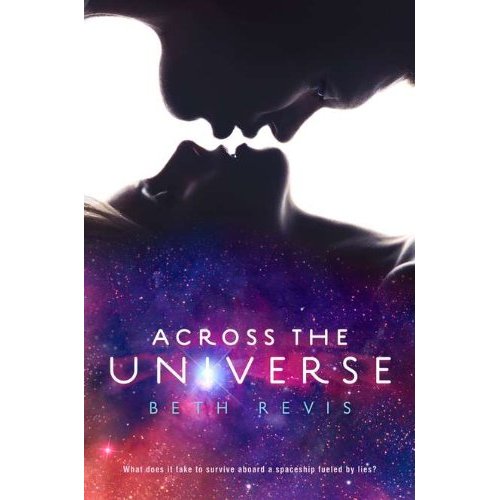
Review: Across The Universe by Beth Revis

Synopsis from Goodreads:


A love out of time. A spaceship built of secrets and murder.

Seventeen-year-old Amy joins her parents as frozen cargo aboard the vast spaceship Godspeed and expects to awaken on a new planet, three hundred years in the future. Never could she have known that her frozen slumber would come to an end fifty years too soon and that she would be thrust into the brave new world of a spaceship that lives by its own rules.

Amy quickly realizes that her awakening was no mere computer malfunction. Someone-one of the few thousand inhabitants of the spaceship-tried to kill her. And if Amy doesn't do something soon, her parents will be next.

Now Amy must race to unlock Godspeed's hidden secrets. But out of her list of murder suspects, there's only one who matters: Elder, the future leader of the ship and the love she could never have seen coming.

Review (with spoilers):

I was excited to read Across The Universe because not only did the synopsis promise an amazing story inside but I'd read a lot of great reviews for it and thus knew that a lot of people liked it and therefore, there would be a strong likelihood that I would too.

I enjoy sci-fi and watching Star Trek. Alas, I didn’t enjoy Across The Universe for the most part. I’ve read Across The Universe can be read by people who don’t necessarily read or enjoy sci-fi but the story left me with a lot of questions.
Technology

The beginning was interesting as Amy makes the decision to go with her parents (in a cryogenic state) on a journey to another planet that would take 300 years to complete. The process of Amy and her parents being put into stasis was very detailed, however Revis had not explained why they were leaving Earth in the first place and I believe that this was an essential piece of information that was overlooked.

Nothing major like an apocalypse could have taken place as Amy wondered about how Jason (her boyfriend) had probably got married and had children and now, 300 + 1 years later, his descendants would be alive on Earth. Furthermore, I wanted to know when the probe that was originally sent to the destination planet left Earth and when (if ever) it came back as Godspeed left in 2036. Shouldn’t the probe have been able to detect signs of life? Additionally, I wanted to know how many light years away the destination planet was meant to be as this is the first thing one should ask when travelling on a space ship.

While the description of how they were put into stasis was thorough, I wasn’t given the reason for why tubes were pushed down their throats. I thought it was because they couldn’t breathe the blue liquid in, but it turned out that they had to breathe that in anyway. Furthermore, though they put eye drops in so they wouldn’t go blind, they didn’t put anything in their ears so they wouldn’t go deaf. Also, how was Amy able to hear through the ice whilst in stasis as the ice would have covered her ears?

The reason for why the ship left a year late was not explained. Nonetheless, human cargo should be put on last. The cryochamber should have had more failsafe devices as there was only one alarm for all the chambers. When the temperature of the frozen person rises, the lid should open automatically so they don’t drown. These felt like grave technological oversights. Amy was pushing at the lid of her chamber when she woke up, but realistically, her muscles wouldn’t have been working properly to even lift her arms.
In truth, the ship had been travelling for more than 450 years, so the cryochambers would have broken down as they were made for a journey lasting 300 years. The question of how many chambers were there in total wasn’t answered. How did the Doctor (and the previous doctors) maintain all of them and repair them if they broke as there would only be a certain amount of spare parts in stock.

There was some interesting technology mentioned in Across The Universe such as grav tubes (similar to elevators but the person needs to be connected to the wi-com system) and floppies- slim, handheld computers. I was surprised there wasn’t better CCTV on board and especially in the cryochamber level. The explanation for how the ship had functioned for so long was that renewable fuel was being used but it didn’t go any deeper than that.

Just before they were cryogenically frozen, Amy’s father gave her the option of remaining on Earth and told her he didn’t think she would come with them. Amy was torn but decided to follow her parents, however, the reader later learns that she didn’t have a packed trunk. For 301 years they took an empty trunk that could have been filled with educational books or other essential equipment.

Content

There were some scenes of a sexual nature which were very graphic and explicit. There were also mentions of incest and some violence. There was nudity and suicide. Amy was the victim of attempted rape which was one of the most shocking moments in the book. As can be seen, Revis deals with some tough and sensitive subjects. However, the one thing that is altered is the swearing, as can be seen from the use of ‘Frex.’

Elder

I grew frustrated of Elder as the story went on; this was mostly due to his ignorance. Throughout the entirety of the book, Elder has only one lesson with Eldest and that is to find the three causes of discord- difference, lack of a strong central leader and finally, at the end of the book he is told the third one- individual thought. Just because Eldest didn’t like him or trust him, didn’t mean that Elder couldn’t have been more forceful in asking for lessons. If he was going to be the next leader, he needed to be educated.

Perhaps the most unbelievable thing was that he didn’t even know the date of when the Plague had happened. Elder admitted to Amy that Eldest had told him about the Plague but that he didn’t know when it had happened. I found this strange because the first question someone asks about an event that happened in the past, is when it happened. If Elder didn’t even know the date of the one significant event that had taken place on Godspeed, I didn’t think he could be a leader.

I found the romance side to be quite dull. As soon as he sees Amy, Elder was enamoured with her. He lusted after her a lot and described her ‘sunset’ hair increasingly as the story went on and this became tedious to read. It seemed like it would become a love triangle with the introduction of Harley, but Amy and Elder were too wrapped up in each other to even notice him sinking into depression.

What annoyed me was when Elder berated Harley for looking at the stars and not keeping watch of the frozens when he, himself hadn’t even taken a watch (actually, Elder doesn’t take a watch until very near the end of the book. Amy didn’t take a watch at all even though she constantly worried over whether her parents were being murdered at that moment).
When Elder does finally take a watch over the frozens, he goes to sleep immediately in front of the elevator which defeated the purpose of a ‘watch’. The straw that broke the camel’s back was that Harley and Elder took their watches without a weapon at hand. They were trying to catch a murderer and they weren’t even armed. What was Harley going to do with only a paint brush? Paint the murderer to death? Why did Elder think the murderer would be scared of him if he saw him sleeping there? They wouldn’t be.

I’d figured out who the murderer was long before it unfolded in the story so it wasn’t a surprise. The list of suspects wasn’t that long. There should have been a few more red herrings thrown in. I realised who the ‘middle’ elder was as well; Orion. As I said, there weren’t many characters to pick from. What I found strange was that Eldest and Doc had never seen the middle elder once in sixteen years, even though he was just there, in the recorder hall. Eldest kept saying he was the leader of the ship, yet he didn’t even know who was running the recorder hall.
All my uses of Elder, Eldest and middle Elder in this review sounds complicated as it’s hard to tell who is who. In Across The Universe, Elder/Eldest are not differentiated from each other in any way, not even by numbers, thus making everything that much more complicated. It’s not even known how many Eldests there have been. Also, it would be very hard to talk about them. The only other Eldest they discussed was the ‘Plague Eldest’, but what was the one after him called? Or the one after that one?

At the end of the book, Elder tells Amy that he unplugged her. I knew that this had been a strong possibility. By this point, I had realised that Elder was as bad as Eldest and the middle Elder. This is because Eldest was prepared to kill people if it suited his purposes and he drugged the populace into submission. Middle Elder callously killed frozens and calmly killed Eldest.
Elder too killed the middle Elder as it suited his purposes. He killed him just when middle Elder was about to reveal to Amy that Elder had unplugged her. Though it was said that he may still be alive, in my opinion, the chances of that would be very slim as he wasn’t prepped at all; the tubes weren’t down his throat, the eye drops hadn’t been put in and so on. He cannot be brought back from that totally unharmed.

When reading, I asked myself why Eldest and Elder would have the same access clearance. I understand that they’re clones and thus have the same DNA but logically, Eldest would have clearance for some of the more top secret information that he wouldn’t want Elder to know. It would have been pretty easy to use voice recognition software instead of fingerprints as their voices are not the same.

Amy

I liked Amy to begin with but as the story went on I felt that she was slow to figure out what was going on and to find the link between the victims which was pretty obvious. At the end, she doesn’t figure out that Steela is going to be killed until after it happens. Also, I didn’t know why she would put the information on her wall as anyone would be able to walk in and see it, including Eldest and Doc.

Though Eldest had threatened to kill her and hadn’t, he didn’t even confine her to her room, or to the Feeder Level. She was allowed to go wherever she pleased even though many of the populace weren’t allowed to. At the end, Amy states that she would correct Earth’s records but she doesn’t know enough to change much.

Other questions I had included:

• Why didn't Orion kill all the frozens at once rather than going around killing them one by one?

• Why would he mark his targets with red Xs as this would let everyone know his targets?

• Why did he pull all the trays out but not flick the switch? You would do it as you went along.

• How did Orion know they might be changed into slaves by the frozens once they reached the planet? And if Eldest told him, how did he know?

Overall, Across The Universe had an interesting premise which I was excited to read about. The pace was slow in the middle, but the beginning and end were good pace-wise. The story had a lot of potential in the beginning and the world Revis created was quite solid and unique. For me, the story picked up at the end but it was too late by then. It left me with a lot of questions. However, people will enjoy Across The Universe if they are looking for light sci-fi with a bit of mystery and romance.
Rating: 2.5/5
Concept: 4/5
Cover: 5/5
Author: Beth Revis

This review is part of Dystopian February at Presenting Lenore.

Thursday, 24 February 2011

Review: The Water Wars by Cameron Stracher

Synopsis from Goodreads:

Welcome to a future where water is more precious than gold or oil-and worth killing for
Vera and her brother, Will, live in the shadow of the Great Panic, in a country that has collapsed from environmental catastrophe. Water is hoarded by governments, rivers are dammed, and clouds are sucked from the sky. But then Vera befriends Kai, who seems to have limitless access to fresh water. When Kai suddenly disappears, Vera and Will set off on a dangerous journey in search of him-pursued by pirates, a paramilitary group, and greedy corporations. Timely and eerily familiar, acclaimed author Cameron Stracher makes a stunning YA debut that's impossible to forget.


Review (with some spoilers):

I wanted to read The Water Wars because of the environmental issues that I knew it would focus on. I wanted to see how people would survive in a world where water is hard to come by. I've seen Water World and enjoyed it.

The cover was interesting and piqued my curiosity. However, the cover is less to do with the character is depicts (Kai) and more to do with the two main characters, Vera and Will, siblings who go on a perilous journey to find him. Though Kai is spoken about a lot in the story, he isn't present as much as I would have liked him to be.

The story opened well. I was able to form a picture of the world Vera and Will inhabited and noted the stark contrast between their lack of water and their access to some sorts of technology and even a gaming centre. I wished Stracher would have given more details on how they lived without water. How did they wash their clothes? What exactly is a 'dry shower'? How do they wash utensils?

They went to school and lived with their parents and one day, Vera makes a friend at the bus stop; Kai. Kai and Vera became friends a little too quickly. In truth, they should have been more wary of eah other, Vera especially due to all the warnings from her dad. 

A month goes past. I think this month should have been explained more. What happened? It was crucial for the development of the characters. Later, Kai tells Vera of a river's existence, which is unheard of in this dystopian world. Vera tells Will and when they go to Kai's apartment to ask him to show it to them the next day, they see the signs of a struggle, a kidnap, and a dead body in the room.

Vera wants to rescue Kai and after some persuasion, Will helps her. At this point, the story speeds up rapidly. Knowing that they and their parents could be in danger, they leave their parents ignorant of what's going on and go off to find Kai based on little to no evidence and a hunch. It turns out that these hunches kept cropping up as the story went on. Vera would always think of another place to try to find Kai and she somehow knew what most of their captors' motives were.

It was a little too convenient when Vera and Will were always captured or rescued just in the nick of time. Most often, others saved them rather than them saving themselves. Another criticism is that the story felt too sketchy. There was a lot of action but the story wasn't detailed enough. It felt as though Vera and Will were swept along in the action, journeying from one place to another without much sense of direction.

There were too many baddies and organisations for me to keep track of. Whilst reading, I couldn't remember what some of the acronyms stood for, such as PELA and WAB. Additionally, there were the Minnesotans, the Illinowas (Illinois and Iowa, I believe), the water pirates and Bluewater. This meant that there were too many characters that weren't developed; ranging from Kai who was introduced early on in the story to Torq, who appears at the end. Characters disappeared quickly from the story and others were introduced hastily, such as Sula.  

Sula conveniently turned up in the story just when Vera and Will needed her and it wasn't believable at all. I couldn't understand why some of the characters who appeared to be 'bad' at the start helped the two main characters, for example, Ulysses. There was a reason for him helping Vera and Will, but overall, some of these characters didn't have strong enough reasons to risk their lives for them in my opinion.

Other things that peeved me was the way Vera would hurriedly drop in a layer of information, which I was surprised she knew. She was very well informed all the time, even though I'm sure they wouldn't have taught her all that at school. Furthermore, the story felt very unrealistic whenever Vera mouthed off to the people who captured her. These baddies had guns, she was at their mercy, yet she just never seemed very scared.

What strengthens this feeling is that some of the dialogue wasn't that good. For example, Nasri had lines such as 'That's for me to know and for you to find out' and in response to Will's claim that he 'won't get away with this', Nasri answers 'But I will.' This use of cliche dialogue didn't help the story.

Whilst some of the characters were 2D, others like Nasri, were caricatures. There was constant description of him hopping from foot to foot and I was offered no explanation as to why that was. Had something happened to him? Was it a habit?

The political aspect of the story was far too complex to explain in this somewhat short book. In the end, everything was sorted out too easily. Perhaps Stracher was trying to make The Water Wars into an epic journey, much like the original Ulysses (Odysseus) that the character in The Water Wars is named after, however I don't believe Stracher achieved this.  The story would have been more interesting if Kai had been at the forefront more and if we had learnt more about his ability.

However, The Water Wars does offer some interesting insight as to what would happen in the world if water became so precious and rare as to start a war over it. Vera and Will did think for themselves and did try to find out what was going on and to find Kai. While it wasn't the most engrossing dystopian story out there, it does offer some food for thought.

I would recommend The Water Wars to readers who are interested in and enjoy reading about environmental issues, dystopian societies and adventure. I don't agree with the comparison of this to the Hunger Games as they are completely different. Overall, Vera and Will were likeable characters and their story is worth a read. Another book to try would be Dark Life by Kat Falls.

Rating: 3/5

Concept: 4/5
Cover: 4.5/5
Author: Cameron Stracher


This review is part of Dystopian February at Presenting Lenore.

Wednesday, 23 February 2011

Review: The Chrysalids by John Wyndham

Synopsis from Goodreads:

The Chrysalids is set in the future after a devastating global nuclear war. David, the young hero of the novel, lives in a tight-knit community of religious and genetic fundamentalists, who exist in a state of constant alert for any deviation from what they perceive as the norm of God's creation, deviations broadly classified as 'offenses' and 'blasphemies.'

Offenses consist of plants and animals that are in any way unusual, and these are publicly burned to the accompaniment of the singing of hymns. Blasphemies are human beings; ones who show any sign of abnormality, however trivial. They are banished from human society, cast out to live in the wild country where, as the authorities say, nothing is reliable and the devil does his work. David grows up surrounded by admonitions: KEEP PURE THE STOCK OF THE LORD; WATCH THOU FOR THE MUTANT.

At first he hardly questions them, though he is shocked when his sternly pious father and rigidly compliant mother force his aunt to forsake her baby. It is a while before he realizes that he too is out of the ordinary, in possession of a power that could doom him to death or introduce him to a new, hitherto-unimagined world of freedom.

Review (Spoilery):

The Chrysalids was an interesting novel to read even though it was not always pleasant as it explored many difficult issues. Nevertheless, it was definitely gripping as I wished to find out what would happen to the central characters.

The Chrysalids, which is set in a post-apocalyptic world after a catastrophic nuclear disaster has taken place many years before, relates the events in the life of David Strorm and his fellow telepaths in a society where deviating from the norm of strictly regulated physical features and overall appearance had dire consequences.

It is related in first person which provides instant access to the narrator’s thoughts, feelings and impressions. David, as an individual from a society where deviating from the prescribed norm, was inevitably affected by this attitude despite having a telepathic ability which was definitely not ordinary.

One memorable incident which was hard to stomach was when David’s aunt asked his mother to swap babies for a few days so that she could get her daughter certified as normal as she had a slight defect and was cruelly refused. Both women had previously had two abnormal births and three abnormal births would result in the mother being thrown out of the house. Wyndham uses incidents such as these to highlight the hypocritical attitudes of people in any society.
As a reader, I cannot help but feel angry at David for Sophie’s banishment to the Fringes and his failure to help her in any way after this point and especially when he meets her again many years later. However, disappointing though it is, I think David’s attitude of moving on and mostly forgetting about his friend after her forced exile was very realistically portrayed by Wyndham.

In David’s society of Waknuk, plants and animals which have mutated from the norm are considered to be offensive and are burnt, but humans who have mutated even slightly such as a person who has six toes rather than five, such as Sophie, are considered to be blasphemies and consequently are sterilised and banished from the society. The use of sterilisation in the novel is eerie as it is reminiscent of occasions in history when disabled people were sterilised to prevent procreation.
The novel had a good, well-constructed plot and the suspense is maintained successfully till the climax. I found the ending quite disappointing as I prefer novels to be neatly rounded off with all loose ends tied. Furthermore, the people who come to the aid of David and his friends are no better than the prejudiced people they are striving to escape. Despite this, it was still a worthwhile read as it is one of the classics in dystopian fiction. I would recommend this book to fans of post-apocalyptic fiction as it deals with society and psychology.

Rating: 3/5
Concept: 4/5
Cover: 3/5

Author: John Wyndham

This review is part of Dystopian February at Presenting Lenore.

Friday, 18 February 2011

Review: Gone (Gone #1) by Michael Grant

Synopsis from back cover:

In the blink of an eye, the world changes. The adults vanish without a trace, and those left must do all they can to survive. But everyone's idea of survival is different. Some look after themselves, some look after others, and some will do anything for power. For Sam and Astrid, it is a race
against time as they try to solve the questions that now dominate their lives. What is the mysterious wall that has encircled the town of Perdido Beach and
trapped everyone within? Why have some kids developed strange powers? And can they defeat Caine and his gang of bullies before they turn fifteen and
disappear too?

Review (Spoilery):

Gone, from the first was a riveting book. It deals with the
challenging scenario of how teenagers would behave if everyone aged
fifteen and above suddenly disappeared in an instant. The fight for
survival is only made many times more difficult when young people,
many of whom are not at all pleasant, suddenly gain astonishing powers. Sam and Astrid must attempt to discover where all the people aged
fifteen and above have disappeared to and why they are trapped and are
unable to leave their town due to a force field which surrounds them.

Grant paints a realistic portrayal of how people would respond if
such a crisis should take place. This was tragically and devastatingly
made evident when Sam discovers the body of a small child of a single
parent who lived in his neighbourhood.

With his own worries, confusion and his struggle to survive and make sense of his drastically changed world, he forgets to look out for the weakest in his society. This was hard for me to accept but I think this is possible in a real life
situation. On the whole Sam was thoughtful and brave as he stuck by
his friends and helped Astrid to find her missing little brother when
the disaster first takes place.

The characters in the book are 3D, believable and vividly constructed.
Sam is the reluctant protagonist who simply wants to fade into the
background and be forgotten so that he can get on with his life, but
he cannot help standing up to face evil and injustice as he is a
natural leader.

The villain of the novel however, is Caine, a cruel
and callous young man with niggling abandonment issues who does not
fail to take full advantage of any opportunity to make people follow
his will and obey him. Undoubtedly, Drake is the worst human character
in the novel, without pity or remorse he is simply driven by his lust
for power and will stop at nothing to gain it. I for one will be happy to see the last of him.

Grant also has in between characters who are neither good or bad but just want an easy life or who are easy to bully and manipulate such as Computer Jack, who although he is extremely intelligent, is easily pacified despite his qualms and twinges from his conscience.

I look forward to seeing what he does with these in between characters in future books. Behind the struggle for power between Sam and Caine is the lurking malevolent power of The Darkness which is the greatest danger to Perdido Beach and I can’t wait to see how this inhuman, sinister character develops in the series as I think that it is the Darkness which is responsible for
more than we know so far.

Grant provides excellent descriptions in his novel and it is easy to
conjure up an image of Perdido Beach and its surroundings as it is so
vividly illustrated by him. In addition, the novel deals with many
ordinary day to day concerns such as finding enough food for the
population and rationing and distributing it fairly in an appropriate
manner. The delegation of work to the survivors in order to accomplish
anything is also a topic which is discussed mainly focusing on the
question who should actually be doing the delegating.

Realising that the young children must all be found and taken care of
and acting on this knowledge is also important. The issue of who makes
a better leader is central to the novel; a leader who quickly takes
control and provides a semblance of order but who is tyrannical under
a thin veneer of civility and persuasive charm or the other who is
undoubtedly a natural leader, has a good heart and has his morality
intact but shies away from being a leader until it's very nearly too
late.

Gone made fantastic reading and I will definitely read the other
books in the series to discover how things work out for the
inhabitants of Perdido Beach, especially for Sam and Astrid.

Rating: 4/5

Concept: 4/5
Cover: 4/5
Author: Michael Grant
 
This review is part of Dystopian February at Presenting Lenore.

Thursday, 17 February 2011

Review: The Sky Inside by Clare B. Dunkle

Synopsis from back cover:

Every year, a new generation of children arrives on a conveyer belt to meet their parents. Every spring, the residents of this idyllic suburb take down the snow they've stuck to their windows and replace it with flowers. And every day passes much the same as any other.

Imagine a perfectly-formed, perfectly-controlled world. And then imagine what will happen when everything comes crashing down...

Review:

I didn't know what to expect from The Sky Inside because the synopsis on the back cover was very vague. The Goodreads synopsis reveals many more of the plot points.

I was pleasantly surprised by the beginning because I found myself very interested in  Martin's (the main character) life in the suburb in which he resides with his parents and younger sister. The residents know that there is a world outside but believe that it's poisonous and that it's much more safe in the suburb.

Martin's father is the packet chief at the factory- which may sound like an unimportant job but is actually quite important. He is the only human that works in the factory to receive 'packets' and to communicate with other suburbs. Martin goes to work with him one day, taking along with him his new birthday present- the Alldog.

The Alldog, who he names Chip, is a bot creature who is very smart. As they go hunting around the factory, Chip unlocks a door which is only for authorised personnel and later they find a guy called Bug, who no one's seen since the year before.  

After this point, because of what happens to Bug, Martin starts to question the suburb more. However, it is not until after his sister is taken away that he really does something about it.
The first hundred pages of The Sky Inside were very good. I was interested in Martin and his world and wanted to learn much more about it than what was offered. It did remind me a bit of The City of Ember, but that was a fleeting impression. In the middle however, the pace slowed down and remained like that to the end.

The ending was very anticlimactic and I was disappointed at the explanation given for what had happened to make the world the way it was now. It felt really unrealistic and improbable and some questions as to what would happen next were left unanswered. However, I can guess what happens and don't think there will be a sequel.

I liked the relationship between Martin and Chip, but did think Chip's cleverness made some situations too easy for Martin to get out of. The secondary characters, such as Martin's parents and friends could have been developed more as it would have made the story much more interesting. I would have liked more description of the scenery to have better visualised the surroundings.
 
Overall, I did like The Sky Inside as it was thought-provoking. The first half of the story held great promise however, the second half didn't live up to my expectations. I would have liked a more thorough explanation at the end. This was a good story and I would recommend it to readers who enjoy the dystopian genre. Though not the best dystopian book out there, it does offer some good reading.
 
Rating: 3.5/5
Concept: 4/5
Cover: 4/5
Author: Clare B. Dunkle


This review is part of Dystopian February at Presenting Lenore.

Review: The Legacy (The Declaration #3) by Gemma Malley

Synopsis from Goodreads:

When a Pincent Pharma lorry is ambushed by the Underground, its contents come as a huge surprise - not drugs, but corpses in a horrible state. It appears Longevity isn't working and the drugs promising eternal youth are failing to live up to their promises. A virus is sweeping the country, killing in its wake, and Longevity is powerless to fight it. When Richard Pincent of Pincent Pharma suggest that the Underground has released the virus, something has to be done to put the story straight and once and for all alert everyone to the truth.

Review:

After thoroughly enjoying The Declaration and liking The Resistance, I was excited to read The Legacy, the third and final book. I had doubts as to whether it would have a fitting ending to the trilogy nonetheless, I started reading it. 

Immediately, I was happy to realise that it was an improvement on the second book as this one stayed close to the plot and didn't deviate from the path too much. In this book, the longevity drugs aren't working anymore (though not everyone knows this) and people are dying in hideous ways.

Richard Pincent blames it all on the Underground who he claims have tampered with a shipment of the drugs (though this doesn't explain why hundreds of people all around the world are dying). Everyone believes him and starts to attack the hidden Underground.

Anna and Peter are living idyllic lives in Scotland with Ben (Anna's baby brother) and Molly (their baby daughter). Anna is very happy to be away from all the conflict in London and wants to remain in Scotland whereas Peter is restless and wants to be a part of the Underground.

The other two main characters are Jude (Peter's half-brother) and Sheila who work as part of the Underground, helping the leader, Pip. I did like how active Jude was in helping others but I was annoyed by his constant need to compare himself to Peter and therefore putting himself down in the process. I kept thinking get over it.

Richard Pincent's main concern was tracking down the original formula for making longevity drugs. The logic is that the formula he has now isn't accurate and therefore the drugs have stopped working. This was Richard's only concern in the book and he would go to any lengths to track the formula down-even hurt his own family. It was unbelievable that the whole world would accept Richard's reason for why the drugs weren't working any more. 

I thought his lies would be found out sooner because Pincent Pharma can't possibly be the only place with scientists. Every other country has their own scientists who would realise what's happening to people and who would question him. Furthermore, whole goverments would be in uproar as deaths are very rare in this global society. For the most part, Richard is left alone to get on with his own hunt for the formula. 

The only person who ever questions him is a member of the authorities called Hilary. Like in the other books, Hilary is lied to and is gullible enough to believe it. The chapters alternate between many characters; Anna, Peter, Richard, Jude, Sheila, Derek, Margaret and numerous sufferers.

I enjoyed this because Malley was able to do this without repeating information again and again. Futhermore, it made the story seem to go by more rapidly. Also, this meant that I was able to see the wider effects of the breakdown of the society due to the failure of the longevity drugs.

The fate of Margaret Pincent was especially interesting to me as throughout the trilogy the reader gets to see her downfall from the esteemed position of Matron of Grange Hall. I liked seeing the relationship between her and her father and learning about her regrets. She felt like a very real character.

The ending held some surprises. Some things that I was certain about earlier didn't play out the way I expected. Though I enjoyed some of the plot twists, the main plot twist (which I won't reveal here) felt wild and unbelievable as it could all have been sorted out much more easily beforehand. Furthermore, the ending was rushed and it would have been better if it was slowed down. One or two major questions that I had were left unanswered and I couldn't understand some of the characters' logic.

Overall, I did enjoy The Legacy. It was a vast improvement on The Resistance, but couldn't quite match The Declaration. It was a fast and easy read with a plethora of interesting characters. I would recommend everyone who enjoys the dystopian genre to read this, after The Declaration and The Resistance, of course. 

Rating: 4/5

Concept: 5/5
Cover: 5/5
Author: Gemma Malley

This review is part of Dystopian February at Presenting Lenore.

Wednesday, 16 February 2011

Review: The Resistance (The Declaration #2) by Gemma Malley

Synopsis from Goodreads:

The year is 2140. Having escaped the horrors of Grange Hall, Peter and Anna are living freely on the Outside, trying hard to lead normal lives, but unable to leave the terror of the Declaration — and their experiences as surpluses — completely behind them.

Peter is determined to infiltrate Pharma Corporation, which claims to have a new drug in the works; "Longevity+" will not just stop the ravages of old age, it is rumored to reverse the aging process. But what Peter and Anna discover behind the walls of Pharma is so nightmarish it makes the prison of their childhood seem like a sanctuary: for in order to supply Pharma with the building blocks for Longevity+, scientists will need to harvest it from the young.

Shocking, controversial, and frighteningly topical, this sequel to Gemma Malley’s stellar debut novel, The Declaration, will take the conversation about ethics and science to the next level.
 
Review:
 
I was very excited to read The Resistance as I enjoyed the first book, The Declaration. In The Resistance, Anna and Peter are finally in a position where they can enjoy some freedom as they have become legal through a tragic event at the end of the first book.

Though Anna and Peter are living together and are both legal now, Peter still wants change and is therefore still working for the Underground. For this reason, he works as a spy when he goes to work for his grandfather whom he hates. His grandfather, Richard Pincent, offers him the job at Pincent Pharma and wants to make amends with Peter.

Anna, meanwhile, is busy raising her baby brother in the hostile neighbourbood and finds it hard to make friends or acquaintances. No one seems to like the sight of the young. One day, a woman approaches her and they become friends. Anna believes that she is different.

The Resistance was an enjoyable book to read, but I found it slow and frustrating because of the lack of communication between Anna and Peter. The story is told in alternating viewpoints between Anna, Peter and a new character, Jude.  Their seperate storylines come together very nicely for the finale.

Jude was an interesting new character but I found what he did on a day-to-day basis-hacking into big companies' networks- somewhat unbelievable as he was sixteen years old and self-taught.

Some aspects of the storyline and the characters' questions and dilemmas were repeated throughout the book. I thought a lot of the problems would have been solved if only Anna and Peter communicated with each other more. The honeymoon period was definitely over in this book.

The story picks up pace towards the end and there were some shocking truths revealed which I felt horrified by. Overall, I did enjoy The Resistance. Though it wasn't as strong as its predecessor- The Declaration, it was still a thought-provoking story.

The story definitely gets more interesting towards the end and I looked forward to reading the last book in the trilogy, The Legacy. If you enjoyed The Declaration, I would recommend you continue. Furthermore, if you enjoy the dystopian genre and questions on ethics, you should pick this one up.

(Okay, I read this about three months ago so forgive me if the review's not that good:)

Rating: 3.5/5
Concept: 5/5
Cover: 5/5
Author: Gemma Malley
 
This review is part of Dystopian February at Presenting Lenore.